 Vox Stella
Forensic astrology is not a substitute for investigation, evidence, testimony, or legal process. For researchers interested in symbolic timing, though, AstroClock Forensic offers a structured way to organize event-chart signals into case-family themes.
These three case studies look at directional alignment. The question is not whether astrology proves what happened. The narrower question is whether the engine output resembled the documented event pattern without forcing unrelated themes into the reading.
Method note: all case summaries below are retrospective and symbolic. The readings do not assign responsibility, identify suspects, replace records, or override official findings.
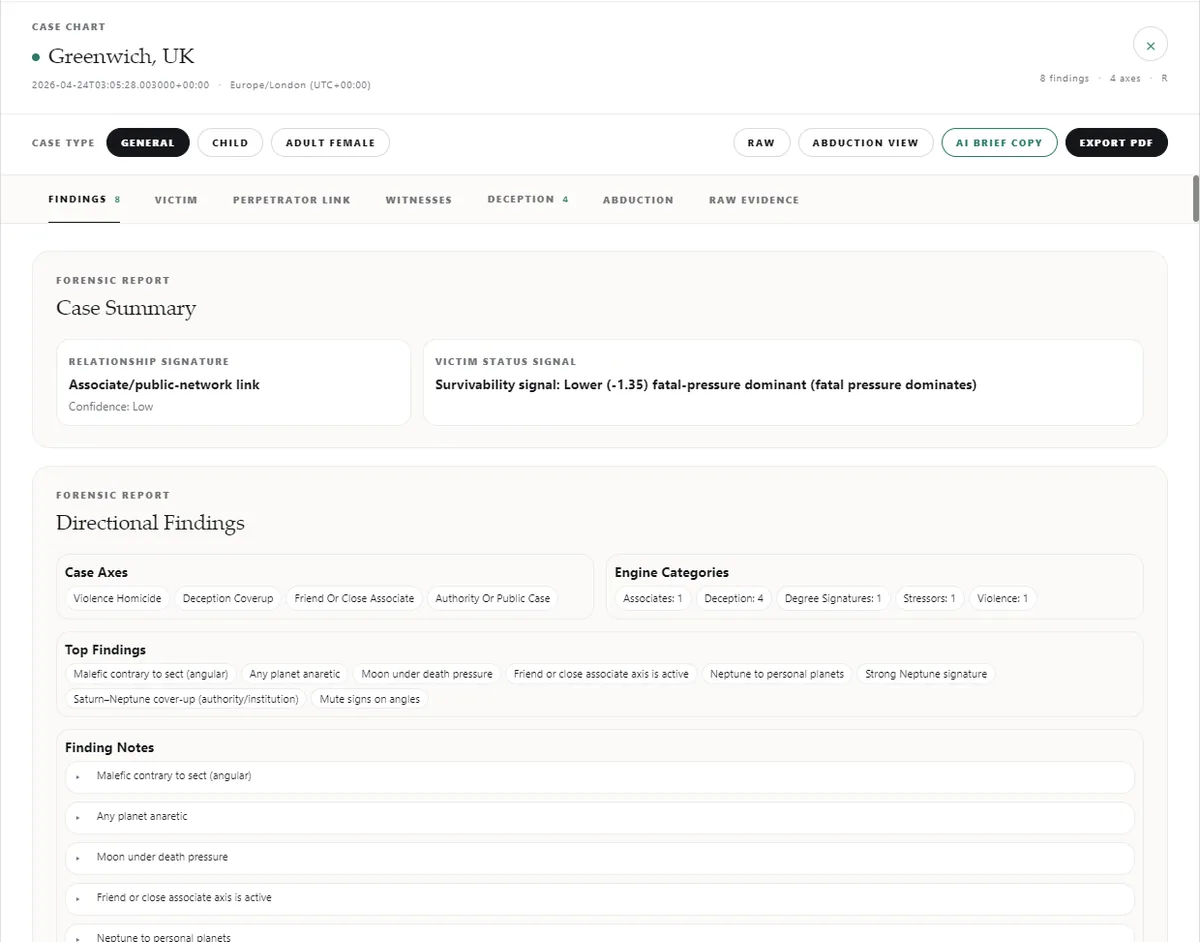
What AstroClock Forensic Analyzes
AstroClock Forensic is an interpretive research aid for event charts. Instead of producing one dramatic claim, it groups symbolic indicators into readable forensic-style categories such as Violence, Abduction, Children, Disaster, Water, Witness, Deception, Family, and Public.
The output also highlights top findings, separates survivability from event type, and preserves uncertainty when the chart anchor is imperfect. A clean event moment is different from a last-seen time, public report time, disappearance window, or emergency-call anchor. The engine is most useful when that distinction remains visible.
For a broader primer, read What Is Forensic Astrology?. For the practical question of which moment to cast, see How to Pick the Right Event Chart for Forensic Astrology.
How Directional Alignment Works
Directional alignment means the chart output resembles the broad documented event family without claiming certainty. A transport-related fatality should show more than generic violence; it should also surface the crash or disaster axis. A child-abduction case should not be framed as a domestic-partner case. A missing-person case with water recovery should preserve ambiguity if the anchor is a disappearance or emergency-call moment rather than a verified death time.
That is the practical value of AstroClock Forensic: it acts less like a conclusion engine and more like a symbolic pattern organizer.
Case Study 1: Crash and Transport Harm Signatures
Netflix describes The Crash as a documentary about a teen who drove into a building, killing her boyfriend and his friend, with what first appeared to be an accident becoming a murder case. The Cuyahoga County Prosecutor's Office reported murder and aggravated vehicular homicide charges tied to the fatal crash, and later appellate records describe the vehicle striking a building after reaching very high speed.
The documented event family centers on an intentional vehicle-crash homicide. The core axes are violence/homicide and transport or crash harm. The contradiction-control test is whether the engine avoids unrelated family-involvement or child-victim framing.
| Result Layer | AstroClock Forensic Output |
|---|---|
| Directional alignment | Aligned |
| Matched axes | violence_homicide, accident_or_disaster |
| Survivability | Lower / fatal_pressure_dominant |
| Categories | Deception, Disaster, Public |
Top findings included active vehicle-crash or transport-harm symbolism, public or authority emphasis, mute signs on angles, and mute signs on the 3rd/9th axis. The useful part is not that the reading found generic danger. It surfaced transport/crash harm alongside fatal pressure while avoiding unrelated child and family themes.
Case Study 2: Elizabeth Smart and Child-Abduction Indicators
Netflix's Kidnapped: Elizabeth Smart presents Smart's abduction at age 14 through documentary material and her own account. Elizabeth Smart's official biography describes the 2002 abduction as one of the most followed child-abduction cases of its time; historical accounts record that she was found alive months later in Utah.
The documented event family is a child-abduction and survivor case. The primary axes are child victim, abduction or missing-person context, and deception or witness pressure. The themes to avoid are domestic-partner involvement, family involvement as the main cause, and accident/disaster framing.
| Result Layer | AstroClock Forensic Output |
|---|---|
| Directional alignment | Aligned |
| Matched axes | abduction_missing_person, child_victim |
| Survivability | Moderate / risk_loaded_survival |
| Categories | Abduction, Children, Deception, Stressors, Violence |
Top findings included a child or parent-child harm cluster, a child home-intrusion abduction pattern, Moon under death pressure, child-case context, and Neptune/deception signatures. The important distinction is survivability. The output was danger-heavy, but it did not flatten the case into fatal certainty.
For a longer single-case treatment, see the existing Vox Stella post on the Elizabeth Smart abduction case study.
Case Study 3: Shannan Gilbert and Water-Recovery Signatures
Netflix's Gone Girls: The Long Island Serial Killer examines the Long Island serial-killer investigation through victims, loved ones, and police. AP's timeline describes Shannan Gilbert's May 1, 2010 disappearance, her 911 call, and the later discovery of her remains in a tidal marsh near Oak Beach; AP also notes the tension between official accident-oriented interpretations and family-held homicide concerns.
The documented event family is an adult female disappearance with later remains recovery near water. The relevant axes are missing-person context, water recovery, fatal pressure, public or authority context, and unresolved uncertainty around classification.
| Result Layer | AstroClock Forensic Output |
|---|---|
| Directional alignment | Aligned |
| Matched axes | abduction_missing_person, water_disappearance_or_drowning, violence_homicide |
| Survivability | Moderate / risk_loaded_survival |
| Categories | Abduction, Deception, Houses, Violence, Water |
Top findings included life/death overlap, Moon under death pressure, foregrounded water signatures, water disappearance or recovery context, a missing-person concealed-route pattern, and strong 12th-house emphasis. This is the strongest uncertainty-handling example because the available anchor is a disappearance or 911-call moment, not an independently established death-time chart.
The survivability label can look counterintuitive because the case ended in remains recovery. With an uncertain anchor, though, the chart may describe the crisis state, search context, concealed route, or ambiguity window rather than a final biological outcome. The reading matched the documented pattern most responsibly when it preserved that ambiguity.
What These Case Studies Show
Across the three examples, AstroClock Forensic did not behave like a single-answer machine. Its value was in structured symbolic comparison: crash harm alongside violence pressure, child-abduction danger without fatal certainty, and a missing-person water-recovery pattern with ambiguity preserved.
| Case | Strongest Match | Method Point |
|---|---|---|
| The Crash | Violence plus transport/disaster symbolism | Contradiction control |
| Elizabeth Smart | Child abduction with survival pressure | Survivability separation |
| Shannan Gilbert | Missing-person, water, fatal-pressure ambiguity | Uncertain-anchor handling |
The practical strengths are case-family patterning, transparent top findings, survivability as a distinct layer, and contradiction control. In forensic astrology, what the engine does not force into the chart can matter as much as what it surfaces.
Responsible Use
AstroClock Forensic should be used as a symbolic research and interpretation aid only. It does not establish facts, assign responsibility, replace police work, replace legal review, or determine what happened in a real-world case.
- Preserve uncertainty when the chart anchor is uncertain.
- Distinguish symbolism from evidence.
- Avoid naming suspects or making accusations.
- Avoid treating survivability as certainty.
- Respect victims, survivors, families, and ongoing legal processes.
FAQ
What does directional alignment mean in AstroClock Forensic?
It means the output resembles the broad documented event family without claiming to prove the facts. A crash case, for example, should show more than generic danger; it should surface transport or disaster symbolism as well.
Why is survivability separate from event type?
A chart can show severe danger without proving a final outcome. Survivability is kept separate so a danger-heavy survivor case, a fatal-pressure case, and an ambiguous disappearance anchor are not flattened into the same reading.
What is contradiction control?
Contradiction control means the engine should avoid forcing unrelated themes into the output. If a case does not involve a child victim, domestic partner, family member, or crash pattern, those themes should not become the center of the reading.
Why does the chart anchor matter so much?
A clean event time can describe a different symbolic moment than a last-seen time, 911 call, disappearance window, or public report time. AstroClock Forensic is most useful when the reader keeps that anchor uncertainty visible.
Sources and Further Reading
- Netflix: The Crash
- Cuyahoga County Prosecutor's Office: Strongsville crash sentencing
- Justia: State v. Shirilla appellate record
- Netflix: Kidnapped: Elizabeth Smart
- Elizabeth Smart official biography
- Netflix: Gone Girls: The Long Island Serial Killer
- AP News: Timeline of the Gilgo Beach killings investigation
- AstroClock Forensic guide
- What Is Forensic Astrology?
- How to Pick the Right Event Chart for Forensic Astrology
VoxStella - Forensics
Forensic event charts, bundled public case snapshots, and structured symbolic evidence review on iPhone and iPad.