 Vox Stella
If you practice forensic astrology, you know the hardest part often isn't reading the chart - it's choosing which moment to cast. Was the key trigger the last confirmed sighting, the 911 call, or the discovery of evidence? In this guide, I'll give you a simple, repeatable framework to pick the best event charts for investigation work. Then I'll show you an app that automates the tedious part: collecting reliable timestamps so you can start interpreting faster.
Ethics note: Forensic astrology is a complementary, interpretive practice. It's not a substitute for law enforcement, legal counsel, or licensed investigators. Always respect privacy, local laws, and the sensitivity of real people's lives.
Table of contents
- What is an event chart (in forensic astrology)?
- The 8 most useful "trigger moments"
- A 5-step framework to choose the right moment
- Data hygiene: timestamps, locations & time zones
- Reading priorities: a fast checklist
- Common pitfalls (and how to avoid them)
- A faster way: my app that auto-finds event charts
- FAQs
1) What is an event chart (in forensic astrology)?
An event chart is a snapshot of the sky for a specific moment and place tied to a case. In forensic astrology, the event chart anchors your interpretation to a verifiable trigger: something that clearly happened - a call, discovery, or public announcement - rather than a feeling or rumor. The better your anchor, the cleaner your chart.
2) The 8 most useful "trigger moments"
When you're deciding which moment to cast, start with verifiable anchors:
- Last confirmed sighting (with reliable witness or video)
- Incident time (when the event likely occurred)
- 911 / emergency call time
- Police arrival / first responder arrival
- Discovery time (e.g., evidence found, body discovered, item recovered)
- Official public announcement (police press time, BOLO release)
- Arrest time (documented booking time is often precise)
- Court milestones (arraignment, verdict, sentencing - if relevant to your inquiry)
Pro tip: Create a short list of 3 - 5 candidate moments first. You'll compare them in Step 3.
3) A 5-step framework to choose the right moment
Step 1 - Define the question narrowly.
Are you asking what happened, where to look, or when a development will surface? Your question determines the anchor.
- What happened? Prefer incident or last confirmed sighting.
- Where to look? Prefer discovery or first responder arrival.
- When will it break? Consider public announcements or arrest times.
Step 2 - Grade each candidate for reliability.
Use a simple score (1 - 5) for:
- Source quality (official record > timestamped news > second-hand posts)
- Time precision (to the minute > approximate window > "afternoon")
- Location certainty (exact address > neighborhood > city only)
Step 3 - Pick your "Core 3."
Select the top three scored anchors. You'll cast all three to see which chart "holds" the case signatures most strongly (angles, rulers, lunar condition).
Step 4 - Sanity check for consistency.
Do your Core 3 show repeating themes - e.g., the same angular planet, repeating degrees, or the Moon emphasizing the same houses? If two charts agree and one is fuzzy, deprioritize the outlier.
Step 5 - Lock the primary & keep the backups.
Choose a primary chart to analyze in depth and keep the other two for corroboration. Note why you chose it (reliability + astrological fit).
4) Data hygiene: timestamps, locations & time zones
- Get the exact place. Street address (or GPS) > city center.
- Time zone & DST. Double-check Daylight Saving rules for the date.
- Convert 12/24-hour formats carefully. 12:05 a.m. vs 12:05 p.m.
- Keep source links. Save URLs or document IDs next to each time.
- Unknown time? Use the best bounded window (e.g., 14:00 - 15:00) and cast the endpoints; look for stability in signatures.
5) Reading priorities: a fast checklist
When you've cast your primary chart, scan in this order:
- Angles & rulers: What's on/near the ASC/DSC/MC/IC (+/-2°)? Who rules the 1st and 7th, and what are they doing?
- The Moon: Phase, speed, last/next aspects, and house placement tell you flow and visibility.
- Tight aspects (<=2°) that connect angles/rulers to malefics/benefics.
- House emphasis: 3rd/9th (messages, roads), 4th (home/end of matter), 8th (forensics), 12th (hidden places/people).
- Planetary conditions: Retrogrades, stations, combustion, cazimi.
- Timing tells: Angular ingresses, applying aspects, lunar void periods.
- Echoes across your Core 3 charts: Repeating degrees/planets amplify relevance.
Keep it grounded: Your chart should illuminate patterns and timing - not replace evidence.
6) Common pitfalls (and how to avoid them)
- Cherry-picking moments. Don't "shop" for a chart that fits a theory. Use the scoring grid first.
- Vague times. If the moment is "around noon," mark uncertainty in your notes and compare multiple casts.
- Forgetting the location. Changing cities can shift angles significantly.
- Overreading symbolism. Strong symbolism is suggestive, not proof. Keep interpretations cautious and ethical.
7) A faster way: the app that finds event charts for you
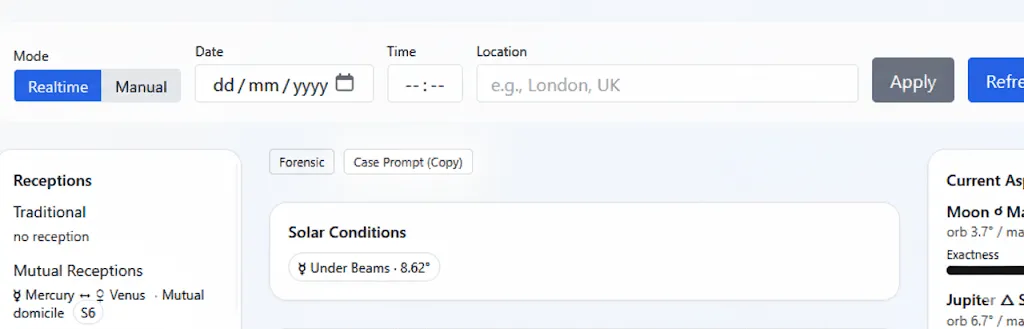
Manually hunting timestamps can eat hours. That's why we built Vox Stella - a lightweight workflow that collects likely event moments for you and lines them up for casting.
How it works (one-click flow)
- Tap "Find Event Charts."
- You're prompted: "What's the case name?" (e.g., Riverside Warehouse Fire 2019).
- The app copies the case name, then an AI searches public sources (news, press releases, court calendars) to extract time-stamped, location-specific events.
- It normalizes time zones/DST, ranks each event by source reliability & time precision, and returns your Core 3 plus backups.
- You can export the list to your astrology software - or open a chart right inside the app.
Why astrologers love it
- Saves hours: No more digging through articles.
- Cleaner anchors: Reliability scoring bakes in best practices.
- Transparent: Every timestamp links back to its source.
- Flexible: Works for incident charts, discoveries, announcements, arrests, and more.
8) FAQs
What is forensic astrology?
A branch of astrology applying event and horary techniques to investigate real-world cases. It's interpretive - not a replacement for official investigations.
Which moment is "best" for an event chart?
The one with the highest reliability (documented time/place) that aligns with your question - often the incident, last confirmed sighting, 911 call, or discovery.
What if I don't know the exact time?
Use a bounded window and test endpoints (and noon). Compare multiple casts and look for stable signatures across your Core 3.
Event chart vs. horary chart - what's the difference?
An event chart is cast for when something happened. A horary chart is cast for the moment the astrologer understands the question. Use whichever matches your method and ethics.
Is this legal or scientific?
Forensic astrology is not recognized as scientific evidence in court. Treat it as complementary insight and always respect laws and privacy.
VoxStella - Forensics
Forensic event charts, bundled public case snapshots, and structured symbolic evidence review on iPhone and iPad.