 Vox Stella
Warren Buffett and Charlie Munger worked together for more than sixty years. Elon Musk and Sam Altman co-founded OpenAI and then very publicly fell out. Steve Jobs and Steve Wozniak built Apple together and then quietly drifted into different orbits. Three of the most-studied business pairings in modern history, and three genuinely different shapes.
This is where compatibility astrology earns its keep as an editorial tool. Run carefully, a compatibility reading should be able to tell a durable pairing from a fracture-prone one, and both of those from a partnership that produces real results without ever being fully stable. That is the distinction most romance-oriented content glosses over, and it is exactly the distinction a work-focused reading is meant to draw.
Editor's note: The three pairs below are public figures used as editorial examples. Compatibility astrology can describe the tone and stress profile of a working relationship. It does not guarantee loyalty, longevity, or commercial success. Nothing here is a verdict on anyone's career, only an illustration of how a compatibility reading behaves across very different kinds of partnership.
What Is Business Compatibility Astrology?
Business compatibility astrology applies chart comparison to founders, partners, colleagues, investors, and creative collaborators. Instead of asking whether two people feel romantic chemistry, it asks whether the working bond looks steady, volatile, productive, or conditional.
That change of frame matters. A business partnership can be influential without being stable. It can produce real work while carrying heavy pressure. It can also look quiet on the surface but unusually durable underneath. A serious astrology compatibility reading should be able to separate those outcomes instead of flattening every important relationship into a positive or negative label.
If you want the broader relationship context first, our guide to birth chart compatibility versus zodiac compatibility explains why full chart comparison tells you more than sign-based matching. This guide is narrower: it focuses on work compatibility astrology and the business-partner question.
Why Compatibility Astrology Belongs at Work, Not Just in Romance
Most compatibility content treats the subject as a matchmaking question: who feels drawn to whom. That is fine for dating, but it is the wrong frame for a business partnership, where the more useful questions are different. Does the pairing hold up under pressure? Can it produce output even when the two people do not agree? Is the structure self-stabilizing, or does it rely on one person continuously repairing it?
Business compatibility astrology is simply compatibility astrology asked those questions instead. A good astrology compatibility reading for collaborators should separate three things:
- Theme: the underlying tone between two charts
- Aspect: the active geometry connecting them
- Burden: the friction or load the pair carries together
In Vox Stella, those components resolve into a composite score and a durability read. The point is not the number itself. The point is what the numbers help you see when you compare pairs side by side.
The Big Three for Work Compatibility
1. Theme - the working tone
The theme layer is the background climate of the partnership. It asks whether the two charts naturally organize around cooperation, status, service, friction, resources, or competing priorities. In business compatibility astrology, this is where the reading starts to show whether a pair has a shared working ground.
2. Aspect - the active contact
The aspect layer describes the active geometry between the two charts. This is where a pair can look lively, mentally engaged, motivating, or tense. Strong contact can make a collaboration important, but contact alone does not make the pair durable.
3. Burden - the load the pair carries
The burden layer is the pressure side of the reading. It helps distinguish a pair that can carry friction from one where friction becomes the dominant story. For business partner compatibility, that distinction is often more useful than asking whether the pair is simply compatible or incompatible.
How the Work Alliance view frames a partnership
Inside Astro Clock, the compatibility workspace includes a Work Alliance view, which is a collaboration-facing frame rather than a romantic one. It asks a narrower question than most compatibility tools: when the emphasis is on working together, does this pair look durable, pressure-heavy, or productive but mixed?
The three cases below illustrate each end of that spectrum and the useful middle.
Step-by-Step Method for Reading a Work Pair
- Define the relationship: founder pair, investor relationship, creative partnership, family business, or long-running colleague dynamic.
- Use the best available birth data: exact times are ideal, but the quality of the source data should always be kept in mind.
- Start with the Work Alliance view: keep the question focused on collaboration rather than romance or general attraction.
- Read the composite and durability label together: a high composite with modest durability is not the same as a high composite with strong staying power.
- Check which layer is doing the work: a pair carried by theme reads differently from one carried by aspect, and one held back by burden reads differently again.
- Compare against known pairs: a new reading becomes easier to understand when you can say it is closer to Buffett-Munger, Jobs-Wozniak, or Musk-Altman.
- Keep the result proportional: compatibility astrology can clarify a working pattern, but it should not replace judgment, agreements, governance, or lived evidence.
Case Study 1: Buffett and Munger as a Durable Collaboration Signal
If you want a benchmark for what a durable compatibility reading for business partners actually looks like, Buffett and Munger are it. In the Work Alliance view, their pairing returns a composite of 86 and a durability score of 83, labeled Durable collaboration signal. The theme layer reads strongly supportive, the aspect layer is coherent, and the burden they carry together is mild. Nothing heroic, just a pair that the reading treats as structurally settled.
That matches the public record almost too neatly: sixty-plus years at Berkshire Hathaway, a working rhythm famous for trust and candor, and a partnership that outlived most corporate marriages several times over.
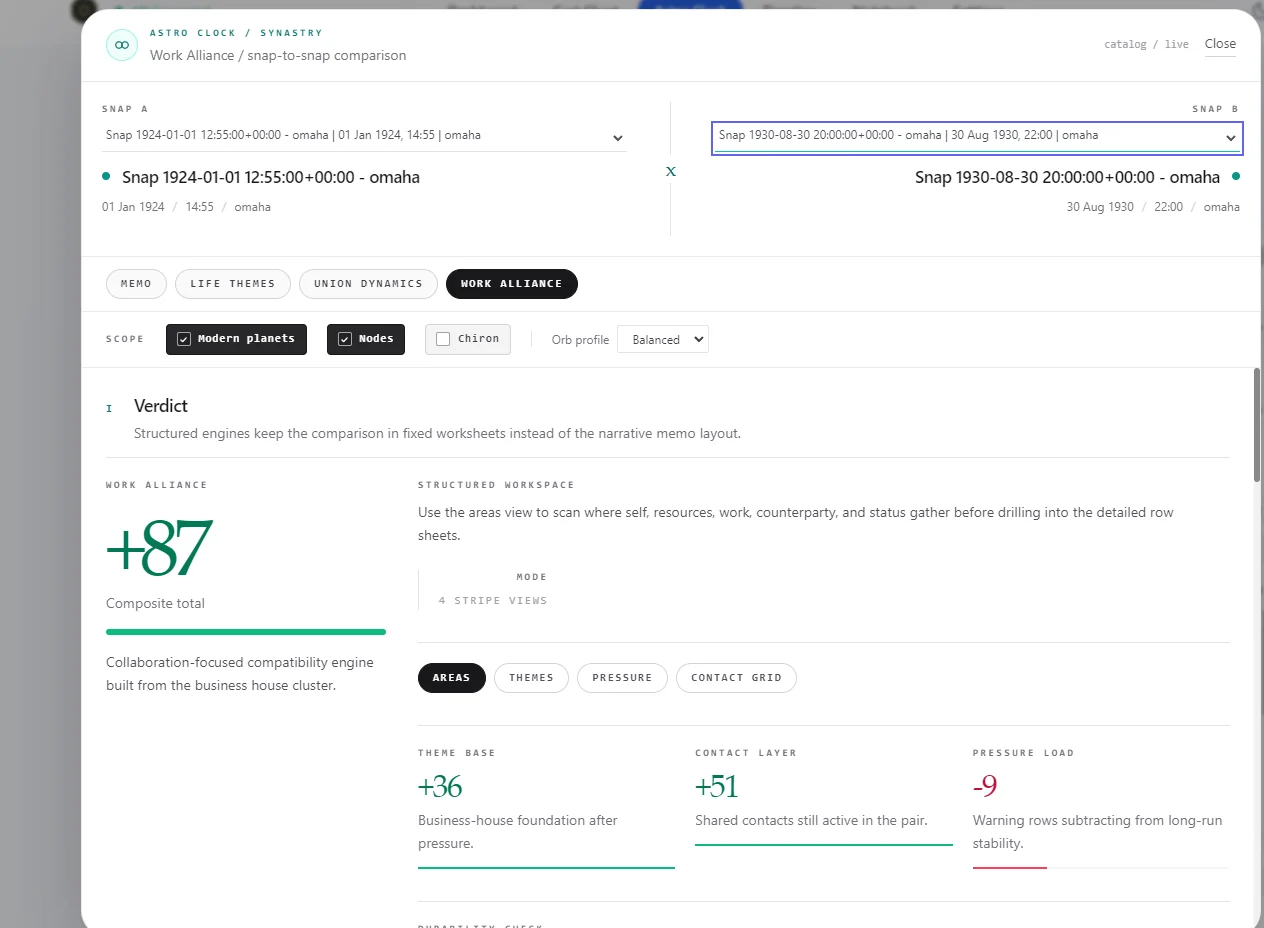
The important thing for editorial purposes is not that the reading is flattering. It is that the reading is steady. Some powerful pairs look magnetic in a chart comparison but unstable. Buffett and Munger read the other way around, quieter than you might expect, and held together by structure rather than spark.
Case Study 2: Musk and Altman as a Breakdown-Prone Pattern
Musk and Altman are useful for the opposite reason. This is a pair that obviously matters, and the compatibility reading does not contest that. What it does contest is the assumption that importance equals durability.
In the Work Alliance view, the pairing returns a composite of -61 and a durability score of 6, labeled Breakdown-prone pattern. The theme layer is sharply negative, the aspect layer is tense, and the burden total is elevated. None of that means the collaboration was fake or wasted. It means the reading treats the structure as loaded, stressed, and more vulnerable to fracture than to steadiness.
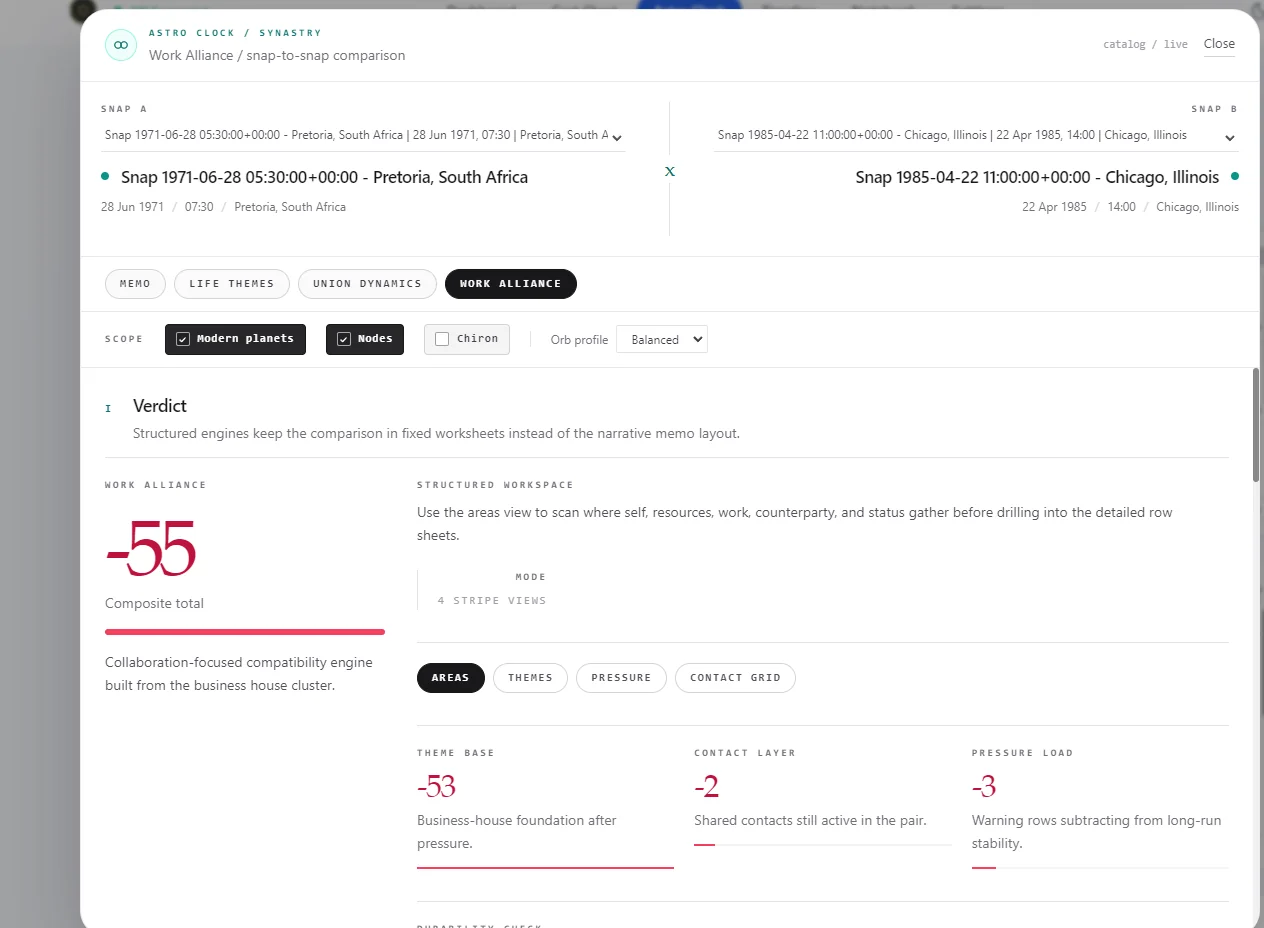
This is where work compatibility astrology becomes genuinely practical. It distinguishes relevance from stability. A partnership can be historically consequential, high-output, and intellectually fertile while still reading as fracture-prone as a working structure, which is a more honest outcome than flattening every notable pair into a single positive verdict.
Case Study 3: Jobs and Wozniak as Productive but Mixed
The middle case is usually the most revealing, and Jobs and Wozniak are a clean example. The Work Alliance view returns a composite of 52 and a durability score of 64, labeled Capable, but not naturally stable. Theme and aspect layers contribute real positives, and the burden layer pulls some of that back.
Translated into plain language: the pair can build, the output is real, and the collaboration is not in the same bucket as an obviously breakdown-prone pattern. But the reading also does not call it self-stabilizing. That lines up with the familiar arc, one of the most important technical partnerships of the twentieth century, and also a partnership that wound down rather than compounded the way Buffett and Munger's did.
Most real business partnerships live in this middle band. They work because the people involved can build something together, not because the structure is automatically balanced. A good business partner compatibility reading should be able to name that plainly, without collapsing it upward into durable or downward into doomed.
Side-by-Side: the Three Pairs at a Glance
Read as a set, the three cases do what a compatibility feature should do: they distinguish between partnerships that look steady, partnerships that look volatile, and partnerships that look productive but uneven.
What to Look for When You Read Your Own Pair
A useful compatibility astrology workflow on a work question tends to follow the same rhythm regardless of who you are comparing:
- Start with the composite to place the pair in context. Is this closer to the Buffett-Munger end of the range, the Musk-Altman end, or the middle?
- Read the durability label alongside it. A high composite with modest durability tells a different story than a high composite with high durability.
- Look at which layer is doing the work. A pair carried by theme reads differently from one carried by aspect, and one held back by burden reads differently again.
- Compare against a known pair. A new reading means more when you can say it looks closer to Jobs-Wozniak than to Buffett-Munger.
This is also why chart-based comparison outperforms sign-based matching. Two full charts carry information that Sun signs cannot, especially when the question is whether two people can keep building together under pressure.
Implementation Playbook: Try the Work Alliance View on a Pair You Actually Know
The most honest test of a compatibility tool is not whether it flatters a famous pairing. It is whether it draws distinctions that match what you already know about people you have worked with. Pick a partnership you have real ground truth on: a co-founder, an old colleague, a family business, or a collaborator who stayed or left. Open the compatibility workspace inside Astro Clock, switch to Work Alliance, and see where the reading lands.
Vox Stella runs as a desktop astrology app, which matters for a practical reason: there is enough room on screen to make this kind of comparison legible rather than cramped. Save the two charts, run the view, and then run a second pair you already have an opinion about and compare the two readings. That is when the tool stops being abstract.
Non-negotiables for responsible use
- Do not treat one score as a final verdict on a person or partnership.
- Do not use compatibility astrology as a substitute for contracts, due diligence, or clear operating agreements.
- Do compare multiple known pairs before interpreting a pair you care about.
- Do keep the reading qualitative: durable, pressure-heavy, mixed, or conditionally productive.
For the wider context of how Vox Stella compares charts beyond the work frame, see the broader compatibility workspace overview.
FAQ
What is compatibility astrology?
Compatibility astrology is the practice of comparing two birth charts to describe the tone, dynamics, and stress profile of a relationship. It can be applied to romance, family, or, as in this article, business and creative collaboration.
Can compatibility astrology predict business success?
No. A compatibility reading can describe whether a partnership looks durable, pressure-heavy, or mixed. It cannot guarantee commercial results, loyalty, or longevity, and a responsible reading will not claim to.
How is work compatibility astrology different from romantic compatibility?
A romantic reading emphasizes attraction and emotional fit. A work compatibility astrology reading emphasizes whether a pair can build and operate together under pressure. The same two charts can read very differently depending on which frame you run.
What does the Work Alliance view in Vox Stella actually show?
It shows a collaboration-facing compatibility profile with a composite score, a durability read, and layered components for theme, aspect, and burden, summarized with a plain-language label such as Durable collaboration signal or Breakdown-prone pattern.
Which business partnerships are the best case studies?
For a calibrated read, use Buffett and Munger as the durable benchmark, Musk and Altman as the breakdown-prone benchmark, and Jobs and Wozniak as the mixed-but-productive middle case. Running those three before your own pair gives you a clearer sense of what each end of the spectrum looks like.