 Vox Stella
Search for zodiac compatibility and you will find endless lists of "best matches" and "worst matches" based on sun signs alone. It is quick, familiar, and easy to share. But if you have ever met someone who was supposedly a perfect zodiac match and still felt misunderstood, or felt deeply drawn to someone your sign was not "supposed" to work with, you have already found the limit of generic compatibility content.
That is where birth chart compatibility becomes more useful. In relationship astrology, a real comparison between two people goes far beyond sun-sign pairing. It looks at how two full charts interact, where the chemistry lives, where communication flows or breaks down, and whether a bond feels light, grounding, intense, or heavy over time.
If you want a practical introduction to this deeper framework, start with Synastry in Vox Stella: A Clearer Way to Read Astrology Compatibility. If you want to see what a structured celebrity comparison looks like, the recent case study Justin Bieber Selena Gomez Synastry vs Justin Bieber Hailey Bieber Synastry shows how chemistry, friction, and attachment can diverge inside a real chart comparison.
What People Usually Mean by Zodiac Compatibility
Most zodiac compatibility content is really talking about sun-sign compatibility. That means the comparison is based on the zodiac sign the Sun was in when each person was born. So when people ask whether Aries and Leo work well together, or whether Virgo and Sagittarius are a strong match, they are usually talking about one part of the chart: the Sun sign.
That is not useless. The Sun sign can say something meaningful about style, temperament, identity, and the way a person naturally expresses themselves. It offers a fast entry point into astrology compatibility. It also explains why horoscope compatibility content is so popular. It is simple, familiar, and easy to follow even if you are new to astrology.
The problem is that people do not build relationships with their Sun sign alone. Emotional responses, communication habits, romantic instincts, attachment style, and long-term patterns are not shown by the Sun sign only. Two people can share strong sun-sign harmony and still clash in real life. Two people can also have signs that look awkward on paper and still form a meaningful, magnetic bond. That is why generic "best zodiac matches" content often feels broadly right but incomplete in practice.
What Birth Chart Compatibility Actually Looks At
Birth chart compatibility compares much more than the Sun. A full chart includes multiple placements and relationship-sensitive themes. In plain language, it helps answer questions like: how do these two people communicate, do they feel emotionally safe together, is there attraction, does the relationship feel easy or demanding, and does the bond create closeness, pressure, growth, or friction?
This kind of comparison is usually called synastry.
Why the Sun Sign Is Only One Piece
The Sun sign matters, but it is only one layer of a much larger picture. A relationship can look smooth at the level of identity and style while feeling much more complicated emotionally. Or the reverse can happen: two people may have very different outer styles, yet feel unusually seen or understood on a deeper level.
That is why people who want a more serious view of birth chart compatibility usually choose to compare natal charts instead of stopping at zodiac matching.
Why Timing and Chart Interaction Matter
A natal chart on its own describes one person. A compatibility reading asks a different question: what happens when two charts interact? That is the key difference.
A relationship is not just Person A plus Person B. It is the dynamic created between them. A synastry chart helps show that dynamic. It highlights where two people connect naturally, where they activate each other strongly, and where they may have to work harder over time. This is also why relationship astrology becomes more useful when it moves away from vague labels like "soulmates" or "bad match" and toward concrete dimensions of interaction.
What Is Synastry in Plain Language?
Synastry is the astrological practice of comparing two birth charts in a relationship context. Instead of asking whether two zodiac signs are generally compatible, synastry asks how these two specific people relate to each other.
That makes it much more personal and much more nuanced. A good synastry chart does not reduce a relationship to one number or one verdict. It looks at different kinds of connection separately. Two people might have strong attraction but uneven communication, high emotional resonance but frequent friction, deep attachment but a heavy long-term dynamic, or easy rapport without much staying power.
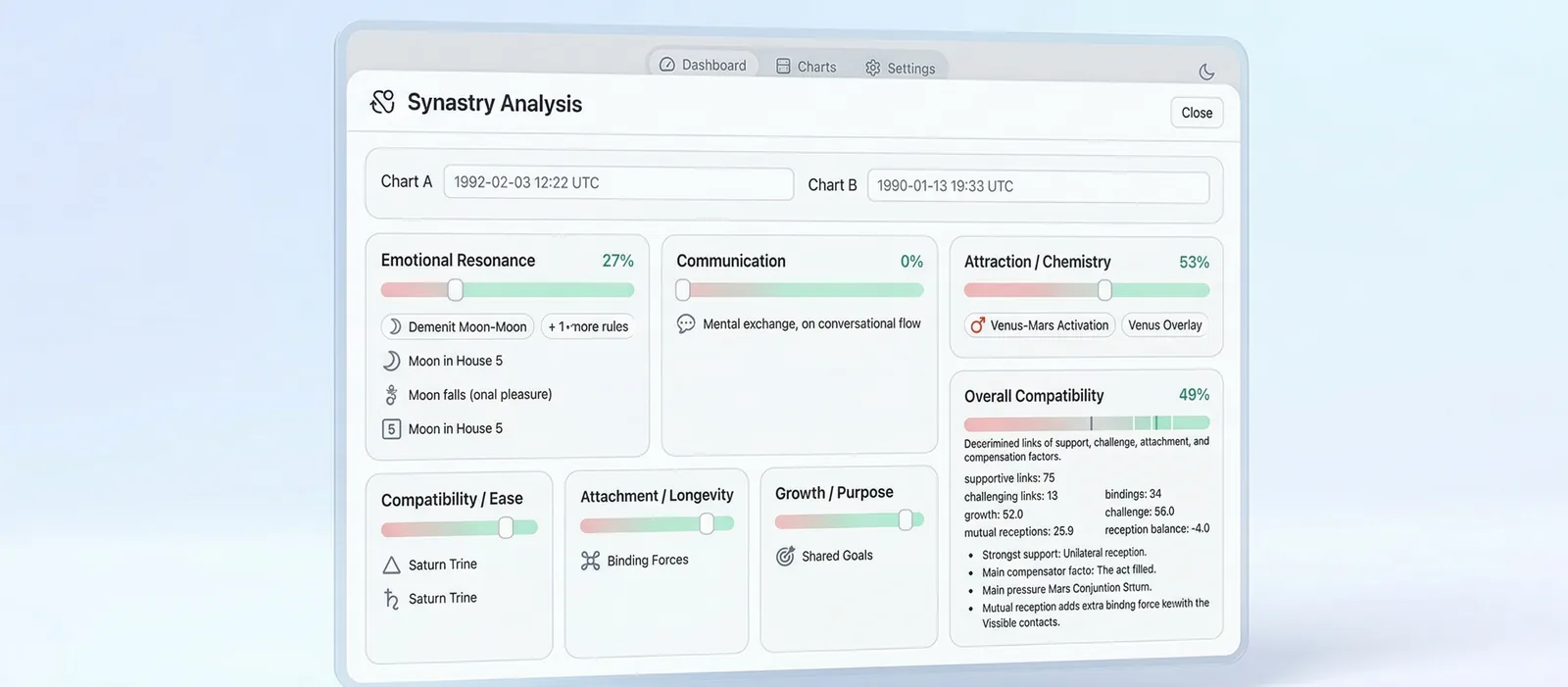
This is what makes birth chart compatibility more useful than generic zodiac compatibility content. It reflects how relationships actually feel: layered, mixed, and sometimes contradictory.
Why Strong Chemistry Does Not Always Mean Easy Compatibility
One of the most helpful things synastry reveals is that not all connection is the same kind of connection.
Attraction and ease are not the same thing
Two people can have obvious chemistry and still struggle in day-to-day compatibility. Attraction can create intensity, fascination, and momentum. But that does not automatically create emotional steadiness, communication clarity, or ease. A bond can be exciting without being restful. It can feel electric without feeling sustainable.
This is one reason astrology compatibility gets oversimplified online. Many people are really asking about chemistry, but chemistry is only one dimension of a relationship.
Attachment and communication are not the same thing
The same goes for attachment. Two people can feel deeply bonded, loyal, or hard to separate from one another and still have misfires in conversation. They may care a great deal, feel tied together, and still leave each discussion feeling unheard.
That is why a deeper synastry reading is often more honest than a basic compatibility percentage. It can show where the bond is strong and where the strain lives at the same time.
Why Structured Relationship Categories Are More Useful Than a Generic Match Score
If you want to understand a relationship, broad labels are rarely enough. A more practical approach is to break the connection into categories. This is where structured birth chart compatibility becomes especially useful. Instead of asking, "Are we compatible?" it asks, "Compatible in what way?"
A useful synastry chart can separate the relationship into dimensions such as:
Emotional resonance
Do you feel emotionally understood together? Is there a sense of comfort, recognition, or mutual sensitivity?
Communication
Can you explain yourself clearly and feel heard? Or do conversations tend to miss the point, escalate, or stay unresolved?
Attraction and chemistry
Is there magnetism, desire, intrigue, or romantic pull? This matters, but it should not be confused with long-term ease.
Compatibility and ease
How naturally do you function together? Does the relationship flow, or does it feel like it takes constant adjustment?
Attachment and staying power
Does the bond create loyalty, commitment, and emotional glue? Some relationships are intense but unstable. Others have real staying power.
Growth and life impact
Does the relationship change you? Some people enter your life and leave a lasting mark, even when the relationship is not easy.
Friction and burden
Where does tension show up? What feels heavy, draining, or difficult to carry over time?
This kind of structure is more useful than a generic match score because it mirrors the questions people actually have. They do not just want to know whether someone is a "good match." They want to know why the connection feels the way it does.
That is also part of what makes an astrology app or astrology software genuinely useful in this area. A good tool helps you see relationship patterns clearly instead of flattening everything into a single percentage. Vox Stella's Synastry feature takes that more structured approach, presenting relationship dynamics visually through score-style categories with supporting astrological indicators.
When Zodiac Compatibility Is Useful, and When It Falls Short
There is still a place for zodiac compatibility. If you are new to astrology, sun-sign matching is a simple starting point. It can help you notice broad themes and elemental patterns. It is easy to remember and easy to discuss.
But it falls short when you want answers about a real relationship. That is especially true if the relationship feels stronger or more difficult than your sun signs suggest, if you want to understand why there is chemistry but not ease, if you feel attached but keep miscommunicating, or if you want a more personal reading than generic horoscope compatibility.
At that point, birth chart compatibility becomes more informative because it describes the actual interaction between two people, not just the reputation of two signs.
A Better Way to Compare Natal Charts
If you want a deeper look at compatibility, the better question is not "What signs match best?" It is "What does this specific connection look like?" That is where it helps to compare natal charts using synastry.
A good compatibility reading should help you identify where the relationship feels natural, where the spark comes from, where misunderstanding builds, what creates loyalty or staying power, and what parts of the bond may feel heavy over time. That is far more useful than reading a generic list of zodiac pairings.
Whether you are exploring a romantic relationship, trying to understand a long-term bond, or simply curious about why a connection feels the way it does, a full-chart comparison offers a clearer picture. Not because it gives proof or guarantees an outcome, but because it is better at separating different kinds of compatibility that often get lumped together.
Final Thoughts
The difference between zodiac compatibility and birth chart compatibility is the difference between a broad stereotype and a more detailed relationship map. Sun-sign matching can be a fun introduction to astrology compatibility, but it only shows one slice of the story.
Synastry goes further. It helps you see whether a relationship is easy, magnetic, emotionally resonant, growth-oriented, friction-heavy, or deeply binding. It also shows why those qualities do not always travel together. Real relationships are rarely one-dimensional. A better compatibility reading should not be one-dimensional either.
See compatibility in more detail
Want a clearer view than generic zodiac matching? Explore Synastry in Vox Stella to visualize relationship dynamics across attraction, communication, emotional resonance, attachment, friction, and more.
Explore Synastry in Vox Stella
FAQ
What is the difference between birth chart compatibility and zodiac compatibility?
Zodiac compatibility usually refers to sun-sign matching only. Birth chart compatibility compares two full natal charts, which gives a more detailed view of communication, attraction, emotional resonance, ease, attachment, and friction.
What is synastry in astrology?
Synastry is the comparison of two birth charts in a relationship context. A synastry chart helps show how two people interact, where they connect naturally, and where tension or complexity may appear.
Is birth chart compatibility more accurate than zodiac compatibility?
It is usually more useful and more specific. Sun-sign matching can highlight broad themes, but birth chart compatibility gives a fuller picture because it looks beyond the Sun sign and compares the relationship dynamically.
Can two people have strong chemistry but low compatibility?
Yes. Two people can have intense attraction or chemistry without having easy day-to-day compatibility. That is one of the clearest insights a deeper synastry reading can reveal.
How can I compare natal charts for a relationship?
You can compare natal charts through a synastry reading or by using an astrology app or astrology software designed for relationship astrology. The most useful tools show multiple compatibility dimensions rather than a single vague score.