 Vox Stella
Searches for synastry, astrology compatibility, and birth chart compatibility usually lead to the same deeper question: how do two people actually work together? Not just on paper, and not just by Sun sign, but in the parts of relationship people genuinely feel: emotional safety, communication, attraction, ease, commitment, and growth.
That is where a synastry chart becomes more useful than generic compatibility content. Synastry is the branch of relationship astrology that compares two full natal charts and studies how they interact. Instead of reducing the match to a simple zodiac pairing, it shows where the charts support each other, where pressure appears, and what kind of bond is being described.
If you want a refresher on natal-chart basics before you compare natal charts, read How to Use Your Birth Chart to Understand Personality and Career. If you are ready to look at the relationship layer, Synastry in Vox Stella is built for that step.
What Is Synastry?
In plain language, synastry is chart comparison. It takes two birth charts and asks how they relate. A synastry reading may consider planetary aspects, house overlays, angular contacts, and recurring themes involving the Sun, Moon, Mercury, Venus, Mars, Saturn, Jupiter, and other key placements. The goal is not to declare two people perfect or impossible. The goal is to describe the shape of the connection.
This is what makes synastry central to birth chart compatibility. It shows where two people may feel naturally understood, where communication flows, where attraction is activated, and where the relationship may require maturity, patience, or time. In other words, it moves the conversation from "Are these two signs compatible?" to "How do these two people affect each other?"
Although synastry is often used for romance, it is not limited to romantic relationships. People also use it for friendships, family dynamics, creative partnerships, and business collaborations. The core question stays the same: what happens when these two charts meet?
Why a Synastry Chart Tells You More Than Sun-Sign Compatibility
Sun-sign compatibility is popular for a reason. It is fast, familiar, and easy to understand. It offers a simple entry point into astrology. But it only compares one piece of each chart, and real relationships are usually more layered than that.
Two people can have a classic "good match" by Sun sign and still struggle with emotional timing or communication. Another pair may have very different Sun signs yet share strong mental rapport, powerful chemistry, and meaningful long-term support elsewhere in the chart. A synastry chart helps explain those differences because it looks beyond the headline and into the relationship itself.
This is where astrology compatibility becomes more useful. Instead of offering a generic label, synastry gives context. It helps explain why a relationship may feel easy in one area and demanding in another, why one bond feels exciting but hard to stabilize, and why another feels quieter but more dependable.
A Better Way to Compare Natal Charts: Reading Relationship by Dimension
One of the biggest strengths of structured synastry analysis is that it breaks the relationship into dimensions people can actually recognize in lived experience. A connection can be emotionally warm but mentally frustrating. It can be highly magnetic but hard to stabilize. It can be easy day to day while still pushing both people to grow.
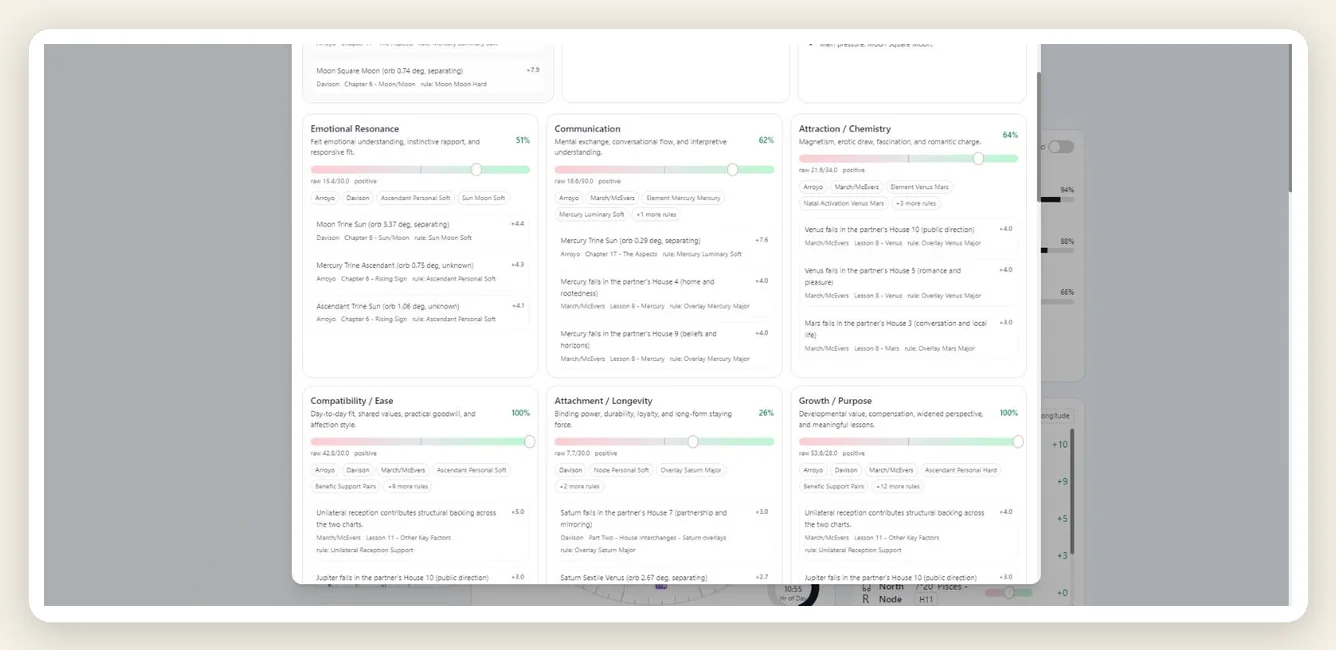
Vox Stella's Synastry view is built around that reality. Instead of one overall number, it separates the reading into clear relationship categories such as Emotional Resonance, Communication, Attraction / Chemistry, Compatibility / Ease, Attachment / Longevity, and Growth / Purpose. Each section is presented visually, with a score bar and the supporting chart factors beneath it.
Emotional Resonance
Emotional Resonance points to felt understanding, instinctive rapport, and whether two people respond to one another in ways that feel natural or reassuring. In many charts, Moon themes, luminary contacts, and certain house interactions shape this dimension strongly. When this area is supported, the relationship often feels emotionally legible rather than confusing.
Communication
Communication is about more than talking often. It includes mental flow, interpretation, listening style, and whether conversations create understanding or friction. Mercury themes often matter here, but the bigger question is simple: can these two people exchange meaning in a workable way? Strong communication does not require perfect agreement, but it does create a bridge.
Attraction / Chemistry
Attraction / Chemistry deals with magnetism, desire, fascination, and romantic charge. Venus and Mars themes often stand out here, along with activating contacts that make the relationship feel vivid or immediate. Chemistry matters, but a good synastry reading keeps it in proportion. Strong attraction may matter a great deal, but it is not the whole story of a relationship.
Compatibility / Ease
Compatibility / Ease speaks to day-to-day fit. Do the charts support goodwill, rhythm, and practical cooperation? Can two people move through ordinary life without constant friction? This category is especially useful for people who care not only about spark, but also about whether the relationship feels livable.
Attachment / Longevity
Attachment / Longevity points toward staying power. It reflects steadiness, loyalty, durability, and the forces that help a relationship hold shape over time. Some charts create intense attraction with little stability. Others build more slowly and feel dependable. Seeing this category separately helps distinguish immediate chemistry from long-term structure.
Growth / Purpose
Growth / Purpose captures something many people notice intuitively: some relationships do not just comfort or attract us, they change us. This dimension can reflect shared vision, developmental value, widened perspective, and the sense that the relationship matters for a reason. It helps explain why a connection can feel significant even when it is not effortless.
Why Structured Synastry Analysis Is More Useful Than Generic Compatibility Content
Generic compatibility content often gives a verdict before it gives a framework. It may say that two signs are naturally aligned, or not, without showing what that means emotionally, mentally, romantically, or practically.
A structured synastry reading is more useful because it shows where the connection is strong, where it is complex, and what is contributing to those patterns. That matters for beginners, who want readability, and for experienced readers, who want more than a surface-level summary.
The visual layout matters too. Score bars help you scan the relationship quickly, while the supporting astrological indicators keep the reading anchored in the charts rather than vague language. The score is not the meaning by itself; it is a guide for attention. What matters most is that the feature shows the factors behind the interpretation instead of hiding them.
Who Uses Synastry?
Synastry is often associated with romance, but the practice has wider use than that. Someone dating may use it to understand attraction versus long-term fit. An established couple may use it to see why communication feels easy while attachment feels serious, or why the relationship is highly developmental even when it is not effortless. Friends or collaborators may care less about chemistry and more about communication, trust, and ease.
This is part of why relationship astrology remains compelling. A good comparison does not reduce people to destiny. It gives language to patterns they may already feel and helps them see those patterns with more nuance.
How Vox Stella's Synastry Feature Makes Chart Comparison More Practical
For an astrology app or astrology software to be genuinely useful, it needs to do two things at once: simplify complex information and preserve enough detail to support interpretation. That balance is where Vox Stella's Synastry feature feels especially practical.
As a desktop astrology app, Vox Stella has room to present multiple relationship dimensions together in a clean, dashboard-style view. You can scan the overall shape of a connection, then read into the supporting factors behind each section. That makes the feature useful for a quick overview, but also strong enough for a slower, more thoughtful chart comparison. If you want the broader app context, the main features overview and product page show how Synastry sits alongside the rest of the platform.
Just as important, the feature avoids the trap of turning astrology compatibility into one all-purpose number. Real relationship astrology is layered. A connection can be easy but not especially magnetic. It can be magnetic but emotionally inconsistent. It can ask for maturity while still offering real growth. Breaking the reading into dimensions respects that complexity and makes it easier to compare two charts without losing the human reality of the relationship.
How to Read Astrology Compatibility Without Turning It Into a Verdict
The best way to use a synastry chart is as a map, not a judgment. A lower score in one category is not a final statement about the relationship, and a high score elsewhere does not guarantee an ideal outcome. In astrology compatibility, patterns matter more than absolutes.
That is especially true with challenging contacts. Tension is not automatically bad. Saturn can feel heavy, but it can also support endurance. Mars can create friction, but it can also create energy and desire. Jupiter can bring optimism and growth, though it may not solve practical issues on its own. The value of a structured synastry reading is that it helps you hold several truths at once.
When you compare natal charts this way, the goal is not to prove whether a relationship will work. The goal is to understand the dynamics more clearly so the reading becomes more honest, more nuanced, and more useful.
Explore Synastry in Vox Stella
For readers serious about synastry, birth chart compatibility, and relationship astrology, clarity matters. A good chart comparison tool should help you see the relationship from more than one angle and show the supporting factors behind the interpretation.
That is what Synastry in Vox Stella is built to do. It brings structure to chart comparison without flattening it into generic horoscope language. To explore relationship astrology in a more practical way, open Synastry in Vox Stella and compare two charts side by side.
FAQ
What is synastry in astrology?
Synastry is the comparison of two natal charts to understand how two people affect each other. It looks at chart-to-chart contacts such as aspects, overlays, and planetary themes to describe emotional, mental, romantic, and long-term dynamics. It is one of the main tools used in relationship astrology.
How is a synastry chart different from sun-sign compatibility?
Sun-sign compatibility compares only one placement in each chart. A synastry chart compares two full birth charts, which makes it more nuanced. That broader view helps explain why a connection may feel emotionally strong, mentally easy, highly magnetic, or more demanding over time.
What does a synastry reading actually look at?
A synastry reading looks at how two charts interact across several layers. That can include emotional resonance, communication style, attraction, practical ease, attachment, and growth. The most useful readings do not just give one answer. They help you see the different dimensions of the relationship.
Can you compare natal charts in an astrology app?
Yes. A good astrology app or astrology software can make chart comparison much easier by presenting a synastry chart clearly and keeping the supporting factors visible. That is especially useful for people who want more than a generic compatibility label and prefer a structured way to compare natal charts.
How should I interpret compatibility scores in relationship astrology?
Compatibility scores are best treated as signals, not verdicts. They can help you scan where a relationship feels stronger or more complex, but they should always be read alongside the supporting astrological factors. A score organizes the reading; it does not replace interpretation.