 Vox Stella
A lot of people come to astrology with one direct question: what career suits me based on my birth chart? It is a fair question, but it is not usually the best place to start.
A birth chart is better at surfacing patterns than naming one exact modern profession. In practice, the more useful question is this: what kind of personality and vocation pattern does this natal chart describe? That shift matters. It turns astrology from a simplistic label-maker into a practical framework for reflection.
That is where Astro Clock is strongest. Instead of promising to name the one right path, it shows how natal-chart structure can surface birth chart personality traits, recurring strengths, tensions, and public-direction themes. It combines an astrology personality report with an astrology career report so users can see how inner patterns and outward vocation signals connect.
Important boundary: Astro Clock does not claim to perfectly predict careers. It works best as a pattern-finding and interpretation tool that helps users think more clearly about personality, vocation, and direction.
Why personality and career are strong use cases for a birth chart
Personality and career are the two areas where most people want structure, language, and direction. Personality comes first because most users want to know how to read personality traits in a natal chart without getting lost in scattered symbolism. A good reading should show consistent tendencies, not isolated labels.
Career is the natural next step because vocation is where personality becomes visible in public life. The question is not only What am I like? but also Where do these patterns tend to show up in work, responsibility, leadership, contribution, or reputation? That is why career and vocation astrology remains one of the most practical forms of natal-chart interpretation.
Put those together, and you get a better framework for career analysis based on a birth chart. Instead of forcing a chart to name one literal role, you can ask what kind of public direction, professional setting, or vocational emphasis it describes. Used well, astrology helps clarify patterns you can test against lived experience. It does not replace judgment.
How Astro Clock approaches trait profile and vocation
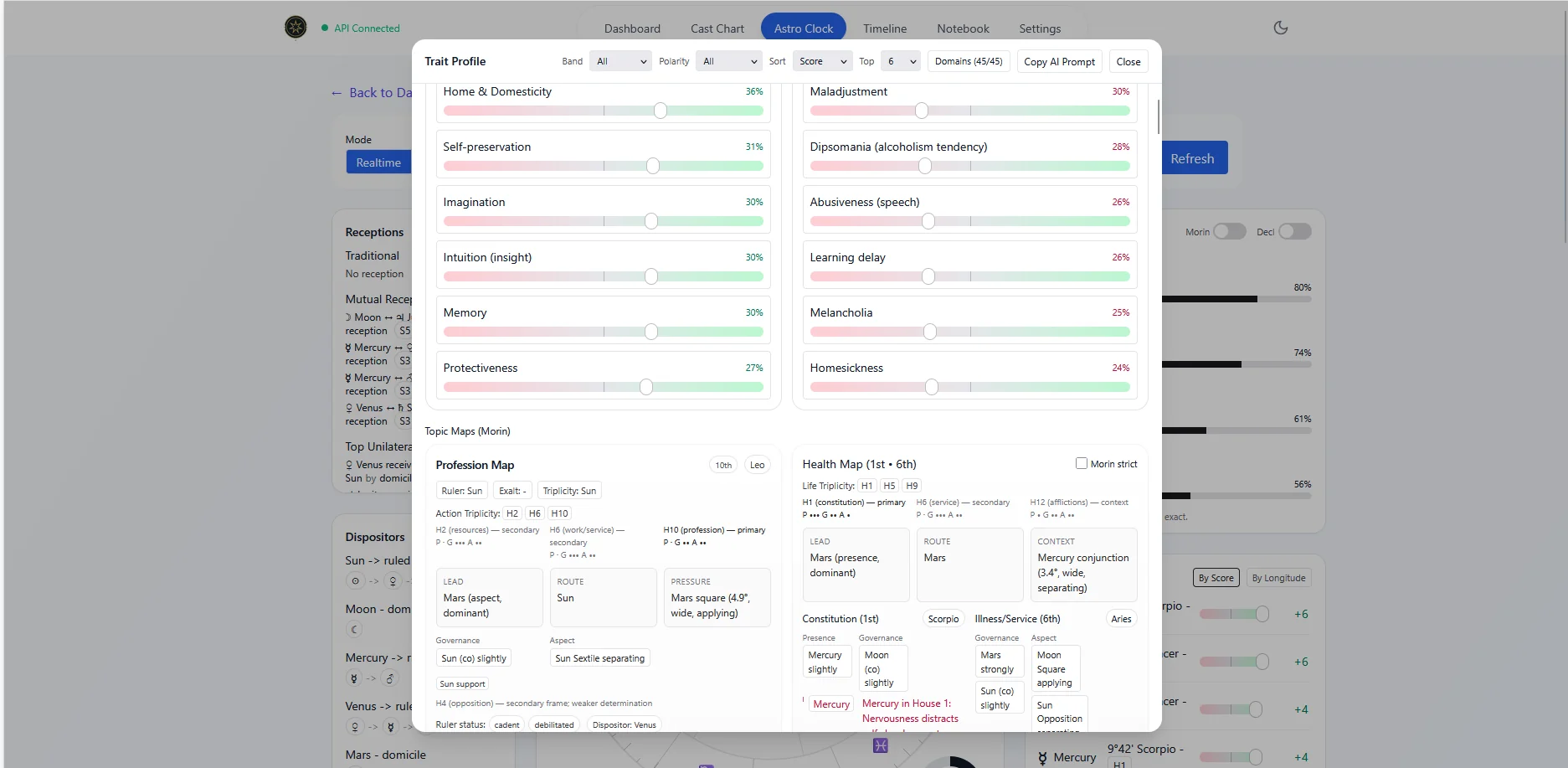
Astro Clock is useful because it does not reduce a chart to one flat output. Its workflow combines four practical layers: summary traits, polarity-aware trait panels, natal-chart house structure, and profession suggestions derived from the 10th house and related houses.
The summary layer gives users a compact starting point. The polarity-aware panels add nuance by showing that traits are rarely one-dimensional. The house-structure layer shows where those patterns are operating. Finally, the vocation layer translates the chart into public-role suggestions rather than one forced answer.
If you want to see the portrait side of this feature, our earlier post on Astrology Meets AI: Trait Profiles & Portraits Therapists Can Use explains how the system turns chart structure into a readable personality workflow. This article focuses on the part users ask about most: how that same structure can help with career reflection.
This is a better model for reading a natal chart for career and personality. It treats the chart as structured information. It also keeps the output honest. In many charts, the biggest insight comes from seeing how trait patterns and house structure reinforce the same vocational direction. That is usually more useful than a narrow answer to what career suits me?
Known-chart comparisons: what they show and what they do not
The best way to judge an astrology career tool is not by hype. It is by comparing outputs against known charts with widely recognized public roles. These examples do not prove universal accuracy. They do show how Astro Clock surfaces vocation patterns in a way that can be practically meaningful.
Donald Trump: strong executive and public-office alignment
Donald Trump's widely known public roles include real-estate developer, television personality, and U.S. president. In Astro Clock, the engine output shows H10 sign: Taurus and H10 route: ruler of 10 in H11. Its synthesis includes the line "Friends/patrons elevate career and reputation." The top profession labels include senior administrator, command, leadership, management, public office, political organizer, and association director.
This is a strong alignment. The software clearly surfaces executive and public-office language. It does not need to name every public role Trump has held to be useful. The core pattern is already there: visible authority, management, status, and network-driven elevation. For the longer comparison, see Donald Trump Astrological Trait Analysis.
Albert Einstein: strong academic fit, partial profession-map fit
Albert Einstein's public roles are widely known as theoretical physicist, academic, and public intellectual. In Astro Clock, the engine output shows H10 sign: Aquarius and again H10 route: ruler of 10 in H11, with the same synthesis line about patrons and reputation. The top profession labels include professor, academia, judge or magistrate, and law. In the summary traits, the software also includes invention_discovery.
This is a partial-to-strong alignment, and that is what makes it useful. The professor and academia outputs are strong hits. The software does not literally output theoretical physicist, but the scientific edge appears more clearly in the trait layer than in the profession map. That is not a failure. It is a reminder that natal-chart career work is strongest when it is used as pattern recognition, not literal profession naming.
What Astro Clock gets right
Astro Clock gets the framing right. First, it treats the chart as a structure that can surface personality themes and vocation patterns. Second, it connects personality and career instead of treating them as separate silos. That matters because people do not experience vocation as an isolated category. Public direction usually grows out of recurring traits, tensions, and emphasis patterns.
Third, the software is honest about different kinds of alignment. Sometimes the fit is strong, as in the Trump example, where public-office and executive language are clearly surfaced. Sometimes the fit is partial, as in the Einstein example, where academic alignment is strong and scientific specificity becomes clearer in the trait-summary layer. That is a better standard than pretending every chart should produce one perfect title.
What the software does not claim
Astro Clock does not claim to guarantee the right profession. It does not claim that these examples prove universal career accuracy. And it does not claim that the software will always name the exact modern job title.
That boundary matters. A responsible astrology career report should help people think better, not make unrealistic promises. Career decisions still involve skills, training, opportunity, experience, and choice. The value of the software is that it gives users a clearer language for understanding what their natal chart may be emphasizing.
How to use this workflow yourself
If you want to use your birth chart to understand personality and career, start with the full pattern, not the final label.
- Start with the summary traits. That gives you the fastest view of what the chart is emphasizing.
- Review the polarity panels. Notice where a trait becomes a strength in one context and a liability in another.
- Read the house structure. This is where the chart shows which life areas are carrying the most pressure and momentum.
- Look at the vocation suggestions. Focus on recurring themes such as leadership, visibility, teaching, analysis, support, or administration.
- Compare the output with real life. Ask which themes already feel true, which ones describe your public direction, and which ones suggest a role you may be growing into.
This is the practical answer to the common question what career suits me based on my birth chart? Do not force the chart to give you one word. Use it to identify patterns of vocation, contribution, visibility, intellect, or leadership. Then test those themes against your real skills and goals.
FAQ
Can Astro Clock predict my exact profession?
No. Astro Clock can surface personality themes and vocation patterns from a natal chart, but it should not be treated as a precise job-title predictor.
Is this more about personality or career?
Both. The workflow is strongest when users read personality and vocation together, because public direction usually grows out of recurring traits and chart emphasis.
Why is the 10th house important in career astrology?
In Astro Clock, profession suggestions are derived from the 10th house and related houses, which makes the vocation layer central to the workflow.
What do the Trump and Einstein examples show?
Trump shows strong alignment with executive and public-office language. Einstein shows strong academic alignment, with scientific specificity appearing more clearly in the summary trait layer.
How should I use the results?
Use them as structured insight. Compare the output with your lived experience, skills, and goals to understand which personality and career themes are most relevant.
See what your natal chart is emphasizing
If you want a more practical way to explore birth chart personality traits and career patterns, Astro Clock helps you move from vague astrology questions to a clearer view of personality structure, vocation signals, and chart emphasis you can actually use.