 Vox Stella
If you want a real forensic astrology example, this Dr. Martin Luther King Jr. assassination chart shows how forensic astrology software in Astro Clock organizes a documented historical event chart into returned axes, categories, and findings before interpretation begins.
That is what this article covers.
We used the assassination chart of Dr. Martin Luther King Jr. inside Astro Clock's forensic feature with exact event inputs and reviewed the output it returned for that setup. The point is not to claim astrology solves crimes, identifies perpetrators, or replaces evidence. It does not. The point is to show how a structured forensic astrology workflow can help users study a chart more consistently and more carefully.
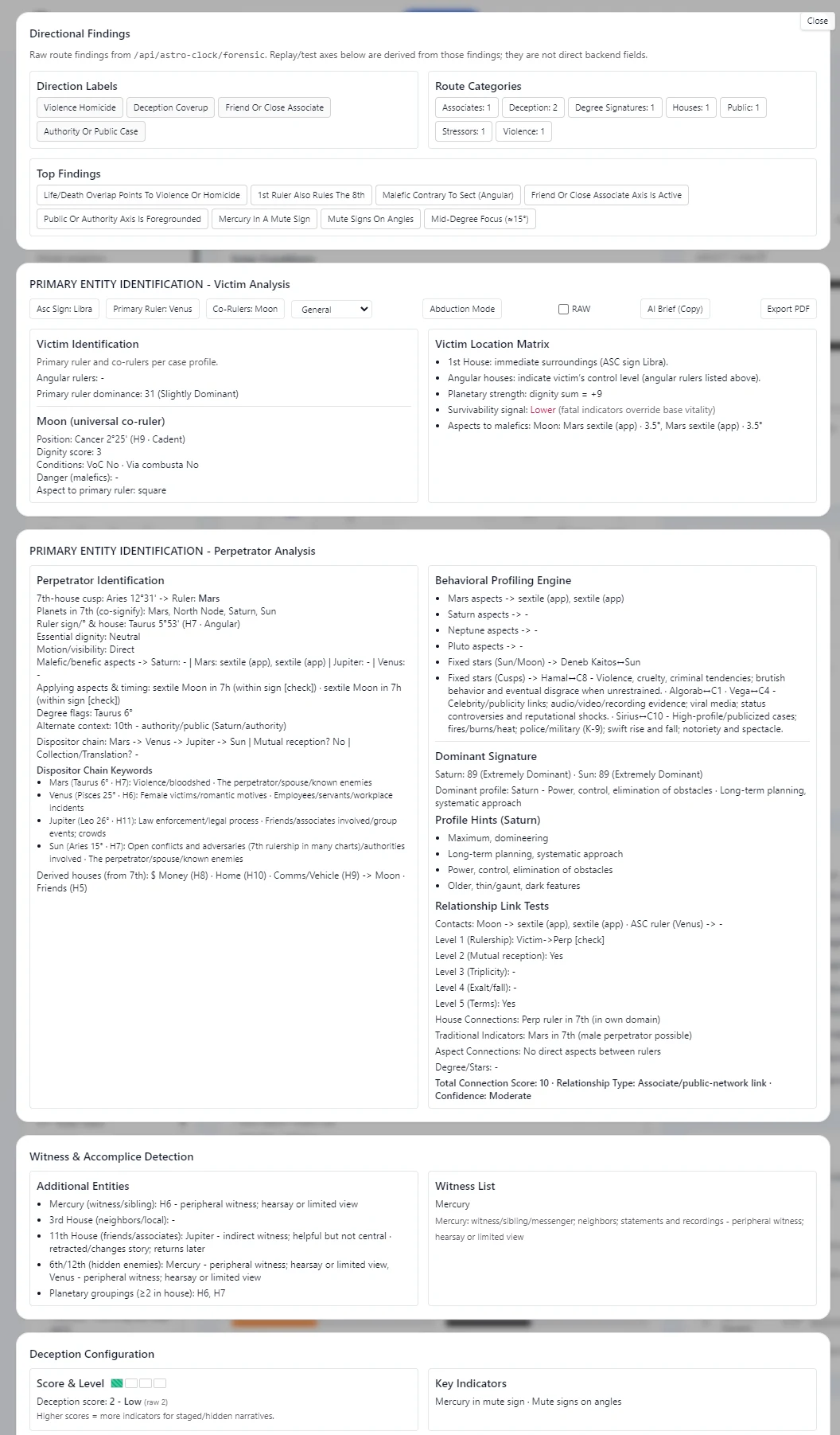
For readers searching for a forensic astrology example, a Martin Luther King astrology chart, a historical event chart, or a real assassination chart astrology walkthrough, this case is useful because it is historically significant, widely recognized, and serious enough to make method matter.
Why this case is useful
This is the kind of case that makes hype fall apart quickly. A chart like this needs restraint, structure, and clear limits.
That is part of why it works well as a case study. People looking up terms like real forensic astrology case study, historical event chart, or astrology crime chart usually do not want vague theory. They want to see the workflow in practice.
Astro Clock is useful here because it gives users a sequence to follow: enter the event cleanly, review the returned axes, check the categories and findings, and only then move into interpretation.
How to use Astro Clock for this historical event chart
This chart was entered with the following data:
- Case name: Assassination of Dr. Martin Luther King Jr.
- Date: 1968-04-04
- Time: 18:01
- Location: Memphis, Tennessee
- Timezone: America/Chicago
- House system code: R
The workflow was simple:
- Open the forensic feature inside Astro Clock.
- Enter the event date, time, location, and timezone exactly.
- Use house system code R.
- Run the analysis.
- Review the returned axes, categories, findings, and comparison status.
- Interpret the result directionally, not as proof.
That order matters. A cleaner workflow starts with exact data, moves to returned output, and leaves interpretation until the end.
What the forensic astrology software returned
For this chart setup, Astro Clock returned the following pattern.
Primary axes
violence_homicideauthority_or_public_case
Secondary axis
deception_coverup
Contradictory axes
family_involvementaccident_or_disasterabduction_missing_person
Categories returned
- Associates: 1
- Deception: 2
- Degree Signatures: 1
- Houses: 1
- Public: 1
- Stressors: 1
- Violence: 1
Top findings returned
- Life/death overlap points to violence or homicide
- 1st ruler also rules the 8th
- Malefic contrary to sect (angular)
- Friend or close associate axis is active
- Public or authority axis is foregrounded
- Mercury in a mute sign
Comparison status
- aligned
Even before interpretation, the pattern is fairly narrow. The strongest emphasis sits around violence or homicide and a public or authority dimension, with deception or cover-up appearing as a secondary layer. Just as important, the contradictory axes did not center accident, family involvement, or missing-person themes as the main fit.
How to read this output carefully
The cleanest way to interpret this kind of result is in layers.
Start with the primary axes. Here, Astro Clock placed the strongest emphasis on violence_homicide and authority_or_public_case. That tells the user where the returned pattern is concentrated.
Then move to the secondary axis. In this case, deception_coverup appeared as a supporting layer rather than the main headline. That does not prove concealment in a legal or historical sense. It means the app surfaced that theme as relevant within the structure of the chart it analyzed.
After that, review the contradictory axes. These help by showing what did not appear as the strongest fit. In this case, the returned pattern did not primarily center family involvement, accident or disaster, or abduction and missing-person themes.
Only then should you move into the individual findings.
- Life/death overlap points to violence or homicide supports the main violence emphasis directly.
- 1st ruler also rules the 8th links identity or bodily symbolism with death-related chart themes in this interpretive framework.
- Malefic contrary to sect (angular) points to a hard, strongly foregrounded stressor.
- Friend or close associate axis is active highlights associate-related chart terrain.
- Public or authority axis is foregrounded reinforces the public-case dimension already visible in the primary axes.
- Mercury in a mute sign is the sort of detail users often explore when communication limits, silence, or obscured information become part of the broader interpretive picture.
This layered approach is one of the main reasons forensic astrology software can be useful. It gives the user a structured starting point instead of forcing meaning out of the chart all at once.
What this does and does not mean
This is where restraint matters most.
What this output does mean is that, for the exact event inputs used here, Astro Clock returned a pattern centered on violence or homicide and public or authority themes, with deception or cover-up appearing as a secondary layer. The comparison status aligned suggests the returned pattern was internally coherent within the app's matching logic.
What this output does not mean is that astrology has solved a crime, identified a perpetrator, or replaced history, evidence, witness records, legal findings, or forensic science.
It also does not mean every returned item should be read literally. A flagged associate axis is not a factual accusation. A communication-related signature is not proof of any single outside fact. These are directional symbolic findings. Their value is in helping users organize inquiry, not in delivering certainty.
Why this forensic astrology software workflow helps users
Many people who are curious about forensic astrology get stuck in the same place. They either over-interpret too quickly or get lost in too many symbols at once.
A practical workflow helps with both problems.
- It gives you a starting point. The returned axes show where to begin.
- It makes the chart easier to read. Categories and findings break the chart into smaller pieces.
- It supports repeatable study. You can run one documented historical event, review the pattern, and compare it with another.
- It helps newer users stay grounded. Instead of jumping straight into dramatic conclusions, you begin with what the app actually returned.
That is where Astro Clock is useful. It does not promise certainty. It helps structure chart review.
Limits and ethics
Any discussion of violent history needs an ethical boundary.
The assassination of Dr. Martin Luther King Jr. was a real human tragedy with lasting historical importance. That means the tone has to remain careful, non-sensational, and honest about limits.
Astrology should not be used to trivialize victims, invent accusations, or act as if symbolic interpretation outranks documented evidence. The responsible use of a case like this is educational: historical chart exploration, method demonstration, and disciplined symbolic study.
The wrong use is false certainty.
Final takeaway
This case is a good example of what a structured forensic astrology workflow can do well. It can take a documented event, return a narrower set of themes, and help the user approach interpretation with more order and less guesswork.
That is different from proving anything. But it is still useful.
If you want to explore historical event charts carefully, the better method is simple: use documented inputs, review the returned pattern first, and keep your interpretation directional and grounded.
If you want a broader introduction before using the feature yourself, start with What Is Forensic Astrology? and How to Choose an Event Chart for Forensic Astrology.
FAQ
What is forensic astrology?
Forensic astrology is a branch of event-chart analysis that looks for symbolic patterns related to crisis, violence, public cases, stress, and other investigative themes. The most responsible use is directional and educational, not evidentiary.
Does forensic astrology solve crimes?
No. Astrology does not replace evidence, legal records, historical research, or forensic science. What it can do is help users study an event chart in a more structured way.
How do I use forensic astrology software with a historical event chart?
Enter the event date, time, location, and timezone, choose the house system, run the analysis, and review the returned axes, categories, findings, and comparison status before interpreting the chart.
What does comparison status aligned mean?
In this context, it means the returned pattern fit together coherently within the app's matching logic for that chart. It reflects internal consistency, not proof of outside facts.
Why use the Dr. Martin Luther King Jr. case as an example?
Because it is historically significant, widely recognized, and serious enough to show why disciplined method matters in forensic astrology.

VoxStella - Forensics
Forensic event charts, bundled public case snapshots, and structured symbolic evidence review on iPhone and iPad.