 Vox Stella
Real estate decisions often come with a narrow window of choice. A buyer may have only a few possible times to submit an offer. A seller may need to choose when to list, when to review bids, or when to sign a contract. A closing may be scheduled around banks, attorneys, agents, inspections, travel, and moving dates.
In practice, property timing is rarely wide open. It usually means comparing a handful of real-world options and asking which window is stronger, cleaner, or more supportive. That is the purpose of the Estate Timing Model in Vox Stella.
This is property election astrology in a practical form: not a generic lucky-day picker, but a focused way to compare real estate timing windows for offers, listings, contracts, and closings.
Editor's note: The Estate Timing Model is an astrological timing aid. It does not predict or guarantee a transaction outcome, and it is not legal, financial, mortgage, inspection, title, appraisal, or negotiation advice. Use it alongside practical due diligence and qualified professional guidance.
What Is the Estate Timing Model?
The Estate Timing Model is a specialized real estate timing astrology tool designed for property-related decisions. Instead of treating a real estate moment like a generic event, it evaluates the chart through a property-specific lens: land, buildings, money, transfer, counterparties, timing pressure, and the person involved in the transaction.
It does not promise that an offer will be accepted, a listing will attract the right buyer, or a closing will happen without difficulty. What it offers is a structured way to compare available property windows for actions such as submitting an offer, listing a property, signing documents, choosing an appointment time, or comparing possible closing windows.
If you are new to electional work, start with our guide to what electional astrology is and why it is used. The Estate Timing Model is a more focused version of that idea, built specifically for real estate actions.
Why Real Estate Timing Needs Its Own Model
Property decisions are different from many other life events because they involve more than personal intention. Buying a home, selling land, signing a purchase agreement, or closing on a property can involve the condition of the property, the financial flow, the other party, the documents, the transfer of value, and the long-term consequences of the decision.
That is why a property timing model needs to look beyond general good-day or bad-day indicators. A window might look pleasant in a general sense but show tension around money, title transfer, or the counterparty. Another window might not look dramatic, but may show steadier support for completion, documentation, or the participant's personal fit with the moment.
The Estate Timing Model is designed to surface those distinctions clearly. It helps users compare windows, understand the reasoning behind a score, and identify where a time looks supportive or cautionary.
What the Model Looks At
The model evaluates the event chart for a real estate action. In plain language, that means it examines the astrology of the specific moment being considered: the time an offer is submitted, a listing goes live, a contract is signed, or a closing takes place.
From there, the model scores property-specific factors rather than relying on one broad indicator. It looks at the property signature, the direction of the transaction, money and transfer indicators, Moon timing, Fortuna support, benefic support, and malefic pressure.
The property signature helps describe the condition, stability, and symbolic strength of the property matter itself. The transaction direction matters because a buyer's chart of action is not interpreted the same way as a seller's chart of action. The flow of value is different.
Money and transfer indicators are central because real estate is not just about finding a desirable property. It is about exchanging value, completing obligations, and moving ownership or possession from one side to another. Moon timing matters because the Moon describes flow, responsiveness, development, and the immediate quality of the moment.
The goal is not to make the user study every internal factor. The model returns ranked windows with visible reasons, so the user can inspect why a window scored well or poorly without turning the workflow into a technical audit.
Buyer vs Seller Timing
The Estate Timing Model supports both buyer-side and seller-side timing. That distinction matters because buying and selling are not mirror images.
For buyers, the emphasis is on acquisition flow. The model pays closer attention to the actor's resources, the act of pursuing or securing property, the relationship between the participant and the property, and whether the moment supports taking on the obligation of purchase.
A buyer might use the model to compare possible times to submit an offer, schedule a viewing, sign a purchase agreement, or respond to a counteroffer. The strongest window is not necessarily the most dramatic one. Often, the useful window is the one with fewer cautions around money, timing, or participant fit.
For sellers, the emphasis shifts toward transfer, completion, visibility, and moving value to the other side. A seller may care about when to list, when to accept an offer, when to sign documents, or when to move toward closing.
Using a Saved Participant Chart
The model can also include one saved participant chart, such as the buyer's chart or the seller's chart. This adds a practical question: does this moment simply look strong in the sky, or does it also fit the person taking the action?
A window can look generally supportive while still feeling poorly matched to the person who must sign, negotiate, transfer money, or commit. Conversely, a moderate window may show meaningful resonance with the participant's chart. For advanced users and astrologers, this can be useful when comparing appointment times or possible signing windows.
The participant chart is optional. The model can still evaluate real estate timing without it. When a saved chart is available, it adds another layer of interpretive context.
How to Read the Output
The Estate Timing Model returns ranked time windows rather than a single magical answer. This matters because real estate transactions rarely unfold under perfect symbolic conditions, and practical constraints often matter more than theoretical ideals.
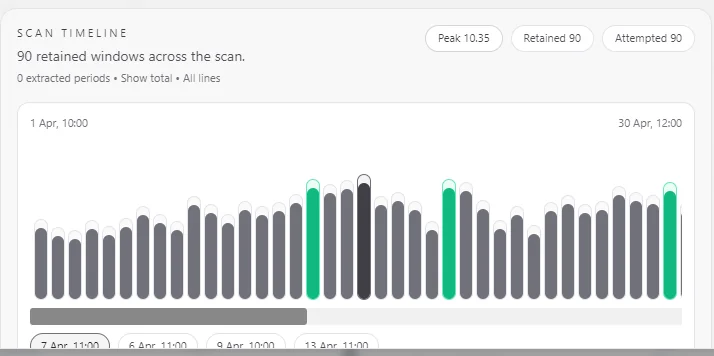
The output is designed to show the strongest available choices inside the scan you actually have. A typical result can include a ranked list of windows, an overall score, an event line, a participant line when a saved chart is used, supportive tags, caution tags, and selected periods.
The event line reflects the strength of the real estate action chart itself. The participant line reflects how well the moment resonates with the saved buyer or seller chart. Supportive tags explain what helped the score, such as Moon phase support, Fortuna support, or benefic property support. Caution tags show what may need extra attention, such as counterparty pressure, timing friction, or transfer-related caution.
Selected periods are useful because real transactions do not always permit exact timestamps. Instead of only showing isolated moments, the model can identify broader stretches where timing remains relatively strong, along with the best timestamp inside that period.
How to Compare Real Estate Timing Windows
When comparing property windows, do not look only for the highest score. A useful reading separates the event chart from the participant fit and then shows where the cautions are concentrated.
- Start with the real-world options: scan the dates and hours that are actually available for the offer, listing, contract, or closing.
- Compare the event line: look for windows where the property action itself has cleaner support.
- Check participant fit: if a saved buyer or seller chart is included, see whether the moment also fits the person taking the action.
- Read the cautions: a higher score still needs practical review when money, counterparty, document, or timing friction appears.
- Use selected periods: if the best timestamp is impossible, look for the strongest nearby period rather than forcing an impractical minute.
A high score does not mean nothing can go wrong. It means the model found meaningful support relative to the other scanned windows. Cautions help keep the reading grounded and point back to practical questions: Is the contract clear? Has the inspection been reviewed? Are financing terms confirmed? Is the counterparty responsive? Are all deadlines realistic?
The timing model supports the decision process. It does not replace it.
Best Use Cases
The Estate Timing Model is especially useful when there are several possible windows and the user wants a structured comparison. A buyer might use it when choosing when to submit an offer, respond to a seller, sign a purchase agreement, or schedule a key appointment.
A seller might use it when choosing when to list a property, review offers, sign listing documents, accept terms, or move toward closing. It can also support astrologers working with clients who are navigating a property move.
The model is also useful for backup options. Real estate rarely moves according to one person's preferred schedule. Banks, agents, attorneys, buyers, sellers, tenants, and title companies all affect timing. In that environment, several ranked windows can be more practical than one ideal moment.
What This Model Is Not
The Estate Timing Model is not a promise that a sale will succeed, a buyer will win an offer, or a closing will happen without difficulty. It is not financial advice. It is not legal advice. It is not a substitute for inspection, appraisal, title review, mortgage planning, negotiation strategy, or professional representation.
A strong timing window can support a well-prepared action. It cannot repair a bad contract, remove hidden defects, guarantee financing, or control the choices of the other party.
The model is best used as an interpretive astrological aid inside a broader decision-making process. For a related example of property-focused astrological judgment, see our horary case study, Will We Sell the House Soon?
A Practical Tool for Property Timing
Real estate timing is complex because property decisions are complex. They involve money, place, ownership, documents, deadlines, and people. The Estate Timing Model was built for that specific context.
For astrologers, it offers a focused framework for property work. For spiritually oriented buyers and sellers, it offers timing support without pretending to replace practical judgment. For advanced users, it provides ranked windows, event and participant lines, supportive tags, caution tags, and selected periods that can be reviewed in detail.
Vox Stella runs as a Windows desktop astrology app. Inside Astro Clock, the broader timing workflow also supports electional work for other decision types. If you are comparing non-property timing, the business launch election guide is a useful companion article.
For users looking for real estate astrology software, the important advantage is not that the model removes uncertainty. It is that it makes the comparison visible: event strength, participant fit, supportive tags, cautions, and usable periods are kept in one place.
When planning a property move or comparing important transaction windows, the Estate Timing Model can help you choose timing with more clarity, more context, and a more grounded sense of the moment.
FAQ
What is real estate timing astrology?
Real estate timing astrology applies electional astrology to property decisions such as offers, listings, contracts, appointments, and closings. The goal is to compare available windows, not to guarantee an outcome.
What can the Estate Timing Model be used for?
It can help compare possible times to submit an offer, list a property, review bids, sign documents, respond to a counteroffer, schedule a key appointment, or choose among possible closing windows.
Can astrology help choose a house closing date?
It can help compare available closing windows from an astrological timing perspective, but it cannot override bank, title, legal, inspection, or contract requirements. Use the strongest practical window, not an impossible ideal.
Does the Estate Timing Model guarantee a sale or closing?
No. It does not guarantee a sale, offer acceptance, financing, inspection outcome, legal result, or smooth closing. It is an astrological timing aid that should be used with practical due diligence.
What is the difference between buyer and seller timing?
Buyer timing emphasizes acquisition flow, resources, and the act of taking on the property. Seller timing emphasizes transfer, visibility, completion, and moving value to the other side.
Can I use a saved participant chart?
Yes. A saved participant chart is optional, but it can show whether a timing window fits the buyer, seller, or other person involved in the transaction.