 Vox Stella
Choosing a wedding date usually begins with ordinary constraints: venue holds, travel, family calendars, budget, and season. For some couples, though, there is a second layer to the decision. If the ceremony marks the formal beginning of married life, is there a time that feels more supportive for that beginning?
That is the practical use of wedding election astrology. It is not a promise of a perfect marriage and it is not an attempt to make logistics disappear. It is a timing tool for people who want to choose a wedding date with more intention.
Need the broader backdrop first? Start with What Is Electional Astrology and Why Is It Used?, then come back here for the wedding-specific workflow and the Alpha vs Beta choice.
What wedding election astrology is really for
Wedding election astrology, also called marriage election astrology, is the practice of choosing a more supportive time for a marriage ceremony. Instead of asking what a relationship means in general, it focuses on timing the start of an event.
People usually turn to it because they want the beginning of married life to feel steadier, clearer, and more aligned with the tone they hope to set. In practical terms, they are often trying to narrow a large date window into a smaller shortlist that feels more thoughtful than random date picking.
That makes it useful for modern couples who want meaning without abandoning reality. A strong wedding date still has to work in real life. Astrology does not replace planning. It helps shape the shortlist.
Why a Marriage Election workflow can help
Open calendars are noisy. Even after couples reduce the list to feasible weekends and ceremony hours, there are usually still too many options to evaluate cleanly. A Marriage Election workflow gives the process more structure.
In Vox Stella, this work lives inside Astro Clock. Astro Clock includes an Election workflow, and one of its supported matters is Marriage. The point is not to tell a couple what their relationship means. The point is to help them compare candidate wedding times with a clearer process.
That is where the first practical question appears: when should you use Alpha, and when should you move to Beta?
What often makes a stronger wedding date
Different traditions weight different factors, but most couples do not need a wall of technical rules. They need a plain-language checklist for what tends to matter when comparing real options.
- A cooperative Moon. Readers often watch for a Moon that supports steadiness, emotional cooperation, and a smoother tone for the ceremony itself.
- Supportive Venus and Jupiter. These are commonly associated with affection, goodwill, ease, and celebration in marriage timing work.
- A protected relationship axis. The event chart still needs a stable frame, which is why the Ascendant and 7th house are usually treated carefully.
- A realistic ceremony window. The best wedding date astrology still has to respect the actual city, venue, travel, and hours that the couple can use.
This is why a structured workflow matters. Instead of chasing a mythical perfect chart, couples can compare candidate times that are both astrologically stronger and realistically usable.
Alpha and Beta are two different passes, not two competing doctrines
The simplest way to think about the Marriage workflow is this: Alpha helps you get oriented, Beta helps you refine.
They are not framed as one being universally right and the other universally wrong. They exist because couples approach wedding timing differently. Some need a cleaner first pass through the calendar. Others want a more relationship-centered second pass once the shortlist is already under control.
Alpha: the clearer first pass
Alpha keeps the original wedding election path. It is usually the cleaner place to start because it is easier to use as a first review of a broader date window.
In user-facing terms, Alpha is best thought of as:
- the original marriage election path
- the clearer first pass
- the simpler way to narrow a broad calendar window
- the practical starting point when you want direction before refinement
Alpha can also optionally layer one natal snap. That makes it flexible for users who want some personal context without making the first pass feel heavy.
For most readers searching best wedding date astrology or how to choose a wedding date with astrology, Alpha is the better place to begin because the first task is usually simple: reduce the noise and find the dates worth examining more closely.
Beta: the more relationship-centered refinement path
Beta uses a dedicated marriage path with chart A and chart B. The important point is not the underlying implementation. The important point is the orientation: Beta is designed for a more couple-centered pass.
In plain terms, chart A and chart B are the two partners' natal charts. In a traditional husband-and-wife framing, one field holds the husband's natal data and the other holds the wife's natal data. In practice, the labels are neutral: partner one can go in chart A and partner two can go in chart B. What matters is that Beta explicitly keeps both people in view during the refinement pass.
That makes Beta a better fit when the first shortlist already exists and the couple wants a more tailored second look.
In user-facing terms, Beta is best understood as:
- a more relationship-centered marriage path
- a better refinement stage once realistic dates already exist
- a stronger choice when both people need to be more explicitly in view
- a second pass for couples who want a narrower, more tailored review
That does not make Beta automatically better. It makes Beta more specialized. Some couples will prefer Alpha even after trying both. Others will find that Beta becomes more useful once the first round of sorting is already done.
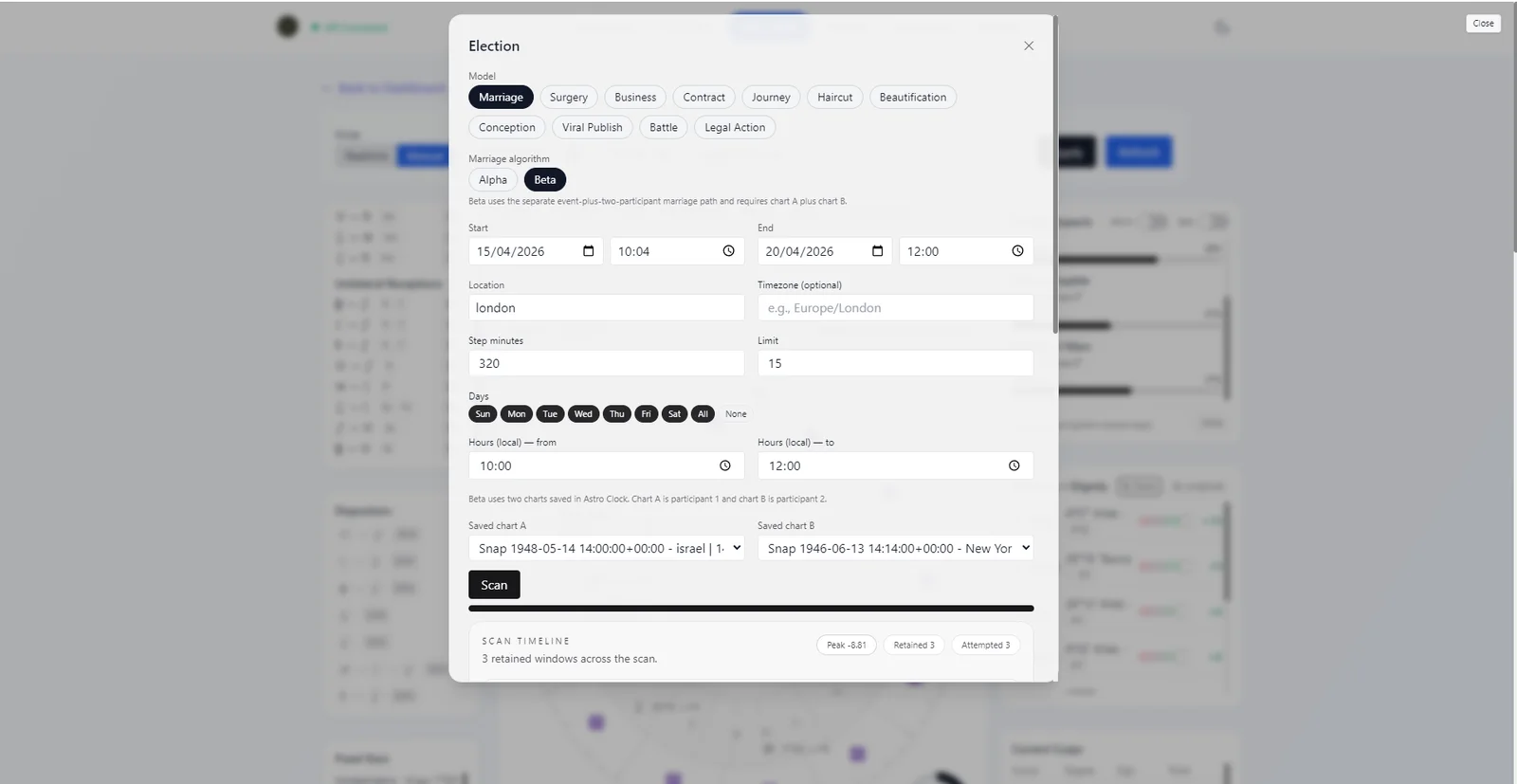
Alpha vs Beta at a glance
| Alpha | Beta |
|---|---|
| Original wedding election path | Dedicated marriage path with chart A and chart B |
| Best for a first pass | Best for refining a shortlist |
| Cleaner starting point | More relationship-centered review |
| Can optionally layer one natal snap | Built for a more tailored couple-focused pass |
If you want the shortest practical summary, use it this way: start with Alpha to orient yourself, then move to Beta when you want a more couple-centered refinement.
A practical way to use the Marriage Election workflow
For most couples, the cleanest workflow looks like this:
- Start with real planning limits. Reduce the window by month, city, venue restrictions, weekdays, and ceremony hours first.
- Run Alpha. Use it to identify promising parts of the calendar rather than obsessing over a single minute too early.
- Build a shortlist. Keep the dates that work for the wedding as a real event, not just as an abstract chart.
- Use Beta for the second pass. Revisit the stronger windows with the more relationship-centered path.
- Make the final decision with both meaning and practicality in view.
This sequence works because it mirrors the way couples actually decide. First they need orientation. Then they need refinement. Trying to force both jobs into one pass usually makes the process harder, not clearer.
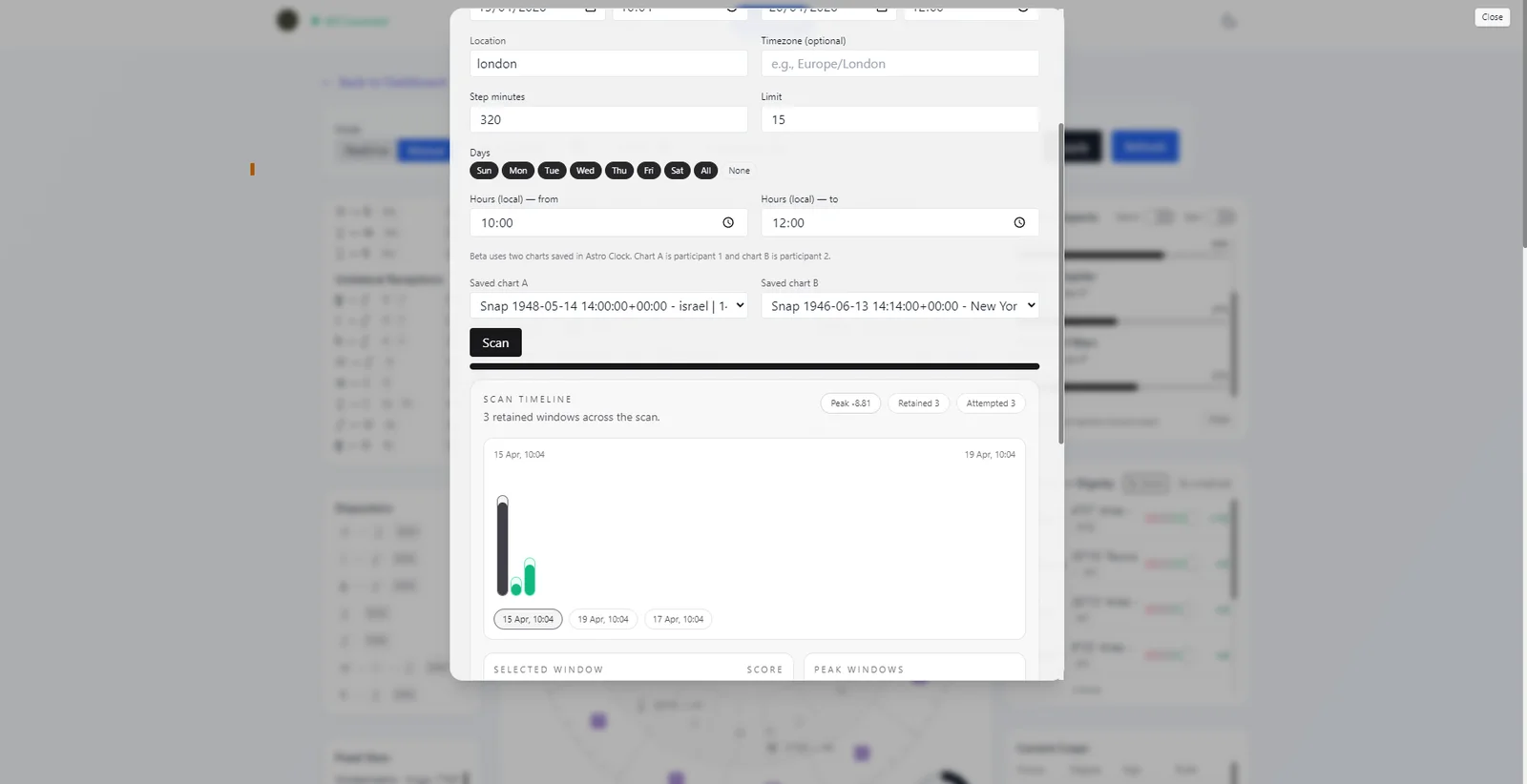
What wedding election astrology should not be expected to do
Wedding election astrology is not a guarantee of a successful marriage. It does not replace maturity, communication, shared values, or emotional work. It does not remove every challenge from married life, and it does not turn one date into a magical solution.
What it can do is help couples choose the beginning more intentionally. For many people, that alone is valuable. A wedding is one of life's clearest threshold moments. Choosing that threshold with more care can feel meaningful, grounded, and appropriate to the commitment itself.
Why this distinction matters in practice
Many people searching for wedding astrology timing, marriage election guide, or how to choose a wedding date astrology are not actually looking for dense theory. They are looking for a workflow they can use.
That is why the Alpha versus Beta distinction matters. It gives couples two clean options that match two real planning stages. Alpha is the clearer first pass. Beta is the more relationship-centered refinement path. Used together, they turn an overwhelming calendar into a more deliberate sequence of decisions.
Want to try it in the app? Start with the Election workspace overview, then use the Windows download page when you are ready to work through Marriage Election inside Vox Stella.
FAQ
What is wedding election astrology?
Wedding election astrology is the practice of choosing a more supportive time for a marriage ceremony. It focuses on timing the event rather than making broad statements about the relationship as a whole.
What is the difference between Alpha and Beta in Marriage Election?
Alpha is the original wedding election path and is usually the clearer first pass. Beta is the more relationship-centered path and works better as a refinement stage once a shortlist exists.
What are chart A and chart B in the Beta workflow?
Chart A and chart B are the two partners' natal charts. In a traditional husband-and-wife framing, one field holds the husband's natal data and the other holds the wife's natal data, but the labels themselves are neutral.
Should I use Alpha or Beta first?
For most couples, Alpha is the better place to begin. Beta becomes more useful when you already have realistic candidate dates and want a more tailored second look.
Can wedding election astrology guarantee a successful marriage?
No. It is a timing tool, not a guarantee. It can help couples choose a more intentional start, but it does not replace compatibility, communication, or effort.
Do I need both charts to use this workflow?
No. A practical starting point is to begin with Alpha. Beta is available when you want the more couple-centered pass that explicitly uses chart A and chart B.