 Vox Stella
Astrocartography is one of the few branches of astrology that quickly becomes practical. The question is rarely abstract. It is usually something like: Where should I live? Which city is better for work? Does one place look better for home life than another? How do I compare several options before I move?
That is why relocation astrology is most useful when it is treated as a workflow, not just a static map image or a long generic report. A map can show possibility. A good workflow helps you narrow those possibilities into real cities, inspect what is nearby, compare serious options, and then read the result with more context.
This is also the logic behind Vox Stella astrology software for Windows. Its Astrocartography feature approaches location astrology as something you use to make clearer decisions about place, not just something you generate once and admire from a distance.
What relocation astrology actually is
Relocation astrology is the broader practice of looking at how place changes emphasis in a chart. An astrocartography map is the map layer. It projects planetary lines across the world so you can see where different themes become more pronounced. A relocation chart astrology reading is the city-specific layer. It recalculates the chart for a chosen location so you can inspect how angles and houses shift there. Local space astrology and parans astrology add more detail when you want to examine directional context, crossings, and local nuance.
These are not competing techniques. They are different ways of answering the same question: how might a specific place bring different parts of a natal chart forward?
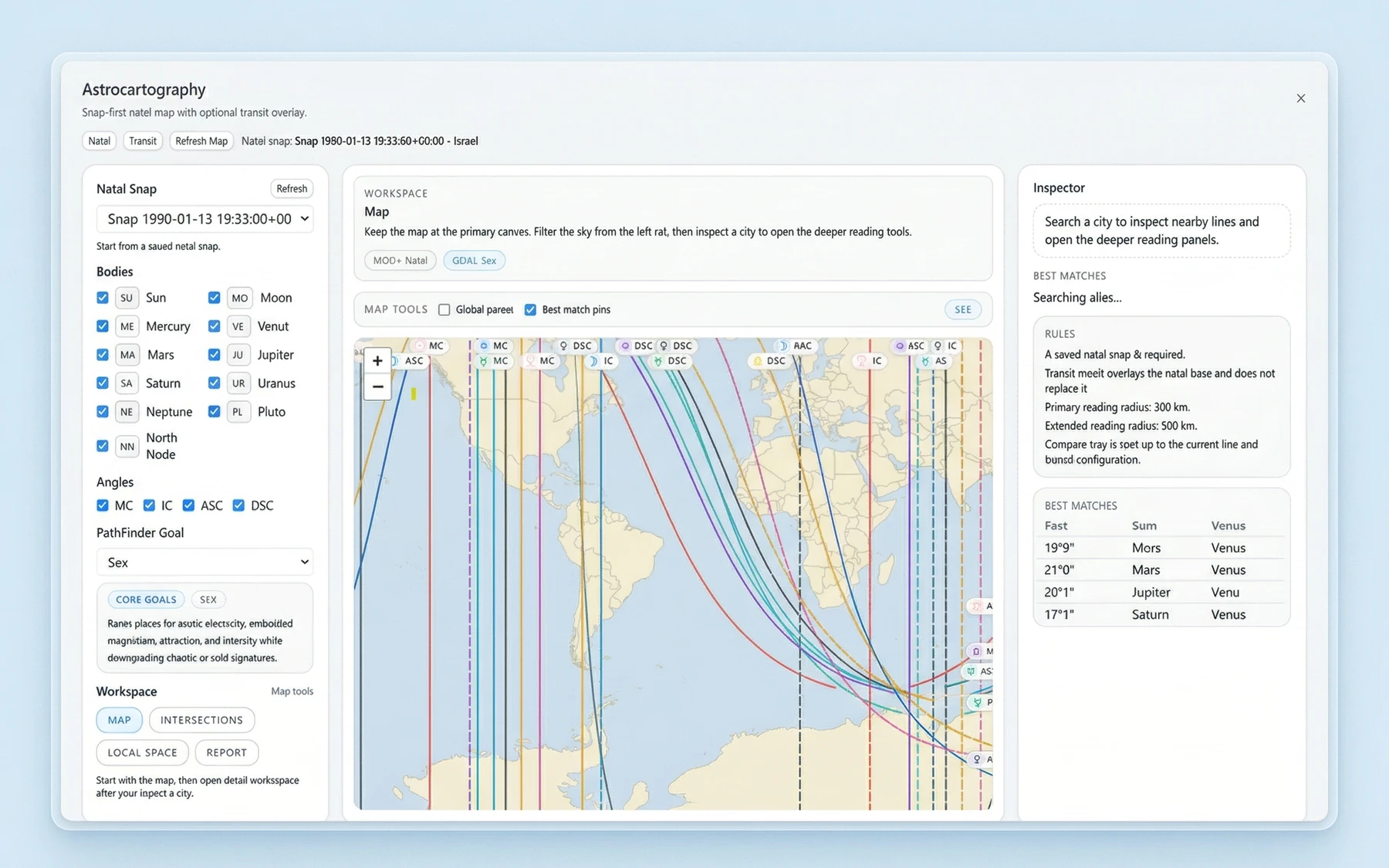
What an astrocartography map shows
An astrocartography map starts from a natal chart snapshot: your birth date, birth time, and birth place. From that foundation, planetary lines are projected onto a world map. Those lines show where planets are emphasized by angle, which is why some places are often read more strongly for public life, home life, relationships, work, money, or other themes.
That does not mean the map promises an outcome. It does not guarantee that a city will deliver love, career success, or an easy home life. A better way to use the map is as a structured lens. It helps you ask better questions about what a place may amplify, what it may demand, and whether that emphasis matches the kind of life you are actually trying to build there.
Astrocartography lines meaning is only the first layer
Many beginners start by reading astrocartography lines meaning in isolation. That is useful, but it is not enough for a real relocation question. A Venus line may sound attractive on paper. A Saturn line may sound difficult on paper. In practice, people do not move to isolated keywords. They move to cities, routines, jobs, housing markets, relationships, and long-term obligations.
The better question is not just, "What does this line mean?" It is, "What does this line mean here, in this city, for this goal, with the rest of the chart still in view?" That is the difference between casual browsing and a serious relocation reading.
How people actually use astrocartography
In real use, astrocartography is rarely about finding one magical location. It is usually about comparing possibilities more clearly. What many people mean when they search for best places to live astrology is not a mystical slogan. They want decision support.
- Shortlisting places to live when the destination is still open.
- Comparing two or three candidate cities before a move.
- Looking for locations that support a specific priority such as home, love, work, money, or career.
- Checking whether a city that already feels important has strong lines or crossings nearby.
- Adding timing context when the present moment matters as much as the place itself.
Used well, astrocartography helps clarify trade-offs. One city may look stronger for public work. Another may seem better for roots and private life. Another may be more social, stimulating, or demanding. That is often more useful than trying to crown one place as universally best.
Why a map-first workflow matters
A lot of astrocartography content still works backwards. It starts with a report, or with a fixed city, and only then tries to explain the place. That can be fine if you already know exactly where you are going. It is less helpful when you are still exploring, which is how most real relocation questions begin.
A map-first workflow makes more sense because it mirrors the actual decision process. You start broad. You see the global pattern. You notice where the strongest regions are. Then you zoom into real cities, inspect nearby lines, compare the serious candidates, and only after that move into deeper interpretation.
That order matters because it keeps the astrology legible. You are not guessing destinations and generating disconnected reports. You are moving from overview to inspection in a way that stays grounded in place.
Where relocation chart astrology fits after the map
The map is the discovery layer. Relocation chart astrology is the inspection layer. Once you have a serious candidate city, the relocated chart helps you see how the chart is re-angled there and which life areas become more active in day-to-day experience.
This is where a practical relocation reading becomes stronger. The map helps you find the cities worth attention. The relocation chart helps you evaluate how those cities may actually shift emphasis once you are there. If you start with random relocated charts before you have a shortlist, the process becomes slow and fragmented. If you start with the map, the chart comes in at the right moment.
What to look for in astrocartography software
If the goal is real decision-making rather than novelty, astrocartography software should do more than generate lines. It should help you move through a usable process without hiding the underlying astrology.
- Start from the natal chart snapshot. The map should stay anchored to the chart it comes from.
- Support exploration before commitment. A world map and city inspection should make it easy to browse first and decide later.
- Handle comparison well. Most people are weighing several cities, not one.
- Let goals shape the search. Home, love, work, money, and career are not the same question.
- Go beyond the basic line view. Local space, parans, intersections, and deeper panels matter once the move becomes serious.
That is the difference between an astrocartography tool that is interesting for five minutes and one that becomes useful when a relocation question is real.
How Vox Stella turns astrocartography into a usable workflow
Vox Stella's Astrocartography feature is built around that practical sequence. The workflow starts from a natal chart snapshot, then opens into a world map with astrocartography lines so the first view is geographic and comparative rather than report-first.
- Optional transit overlay for moments when current timing matters alongside the natal pattern.
- City inspection so you can look at nearby lines around real places instead of reading the globe at a distance.
- Best-city atlas search to surface candidate locations by theme instead of relying only on manual browsing.
- Compare cities when the decision is between several realistic options.
- Relocation scoring to make the overall pattern easier to scan without hiding the logic behind it.
- PathFinder goals such as Home, Love, Work, Money, Career, Beliefs, Friends, and Sex so the search reflects the question you are actually asking.
- Local space tools, parans, and intersections for deeper work once a candidate city becomes more than a passing idea.
- Inspector and report panels so interpretation stays readable instead of turning into scattered notes and screenshots.
The important point is not simply that the feature has more output. It is that the output is ordered in a way that helps you think through a relocation decision more clearly. If you want the broader product context, you can explore the broader Vox Stella feature set before opening your own map.
A practical way to compare cities with astrocartography
Imagine you are choosing between three cities. One seems promising for career. One feels emotionally right. One makes sense on paper because of work, budget, or family reasons. This is where static line descriptions stop being enough. You do not need three disconnected readings. You need one comparison workflow.
- Start with the map to see the broader regional pattern instead of committing to one city too early.
- Use a PathFinder goal such as Career, Home, Love, or Work so the search reflects the real purpose of the move.
- Inspect each city for nearby lines and crossings, not just exact textbook matches.
- Compare the candidates side by side so the differences are visible: one city may emphasize public recognition, another belonging, another relationships, another stimulation.
- Bring in the relocation reading and optional transit overlay once the shortlist is serious and timing matters.
Used this way, astrocartography becomes less about finding a perfect place and more about understanding trade-offs. One city may look stronger for work but less rooted for home life. Another may feel better for relationships but less compelling professionally. Another may be energizing but too intense for a long stay. That kind of distinction is exactly what a good comparison flow should make easier to see.
Before you relocate, inspect the layers people often miss
Local space astrology adds nearby directional context
Once the broad map has done its job, local space astrology helps you think at a more immediate scale. It is especially useful when the question is not only "Which city?" but also "How does this place work locally, directionally, or in relation to my current base?" For serious users, this extra layer often helps refine a promising location rather than replace the main map.
Why parans astrology matters before a move
Parans astrology and intersections matter because cities are rarely defined by one line alone. Crossings can sharpen, complicate, or redirect the tone of a place. If you are evaluating a serious move, these details can be the difference between a generic reading and one that feels specific enough to trust as part of a larger decision process.
This is also where good presentation matters. Advanced detail only helps if the software surfaces it clearly. If local space, parans, crossings, and inspector data are buried or scattered, the workflow breaks down at exactly the moment it should become more useful.
What astrocartography can and cannot do
Astrocartography can help you frame location more intelligently. It can show why two cities may feel very different, why one place looks better suited to public life while another seems better for roots or relationships, and why a relocation chart deserves a closer look before you move.
What it cannot do is replace judgment. It does not remove the need to think about visas, salary, language, housing, family obligations, health care, or whether you actually want the life a city would require. Good astrology for moving location should add structure to a decision, not pretend to remove the uncertainty from it.
That is why the most useful question is usually not, "Where is my destiny?" It is, "Which of these places best supports the version of life I am trying to build now?"
A clearer way to do a relocation reading
If you want astrocartography software that helps you explore places, inspect nearby lines, compare cities, and keep the reasoning visible, Vox Stella's Astrocartography feature is built for that kind of work.
It gives you a map-first workflow, goal-based search, city comparison, relocation scoring, and the deeper tools that matter once a move becomes serious. If that is how you want to work, download Vox Stella for Windows and try your own map, shortlist, and relocation questions in one place. You can also read Synastry in Vox Stella or explore election timing if you want the rest of the platform's decision tools around the same workflow.
FAQ
What is relocation astrology?
Relocation astrology is the branch of astrology that studies how place changes emphasis in a chart. It usually includes astrocartography maps, relocation charts, and sometimes local space or parans. The goal is not to promise outcomes, but to understand how different locations may highlight different life themes.
What is the difference between astrocartography and a relocation chart?
Astrocartography is the map view. It shows where planetary lines fall across the world. A relocation chart is the city-specific view. It recalculates the chart for one chosen location so you can inspect how angles and houses shift there. In practice, the map helps you discover candidate places, and the relocation chart helps you evaluate them more closely.
Can astrocartography help you choose where to live?
It can help you compare locations more clearly, especially when you are choosing between several cities or trying to match a place to a goal such as home, love, or career. It works best as one input in a larger decision that also includes practical realities such as work, budget, family, and legal constraints.
Do you need an exact birth time for astrocartography?
An exact birth time is strongly preferred because line placement depends on accurate timing. If your birth time is approximate, you can still explore the map cautiously, but the closer you want to get to city-level comparison and relocation reading, the more important timing accuracy becomes.
What are local space and parans in relocation astrology?
Local space adds directional and nearby geographic context. Parans describe crossings or simultaneous angular relationships that can change the tone of a place. They are often used as deeper inspection layers once a city or region is already under serious consideration.