 Vox Stella
Fertility planning can be both practical and deeply personal. Some people track cycle patterns, cervical fluid, basal body temperature, ovulation timing, or hormone markers. Others are navigating professional fertility treatment and want a way to feel more connected to the timing process without confusing astrology with medical care.
Vox Stella's Lunar Fertility Windows report is designed for people who want a symbolic astrology layer beside existing fertility awareness tools. It does not replace ovulation tracking, medical testing, diagnosis, fertility treatment, or clinical instructions. It offers a Jonas Method-style fertility window report based on the relationship between the Sun and Moon in your birth chart.
Medical disclaimer: This report is an astrology-based timing and reflection tool. It is not a medical fertility test, ovulation test, infertility diagnosis, treatment plan, sex-selection method, or pregnancy predictor. Always consult a qualified healthcare provider or fertility specialist for reproductive health, ovulation, infertility, or treatment decisions.
What Is a Jonas Method Fertility Window?
A Lunar Fertility Windows report is an astrology-based timing report that identifies symbolic fertility periods across a future date range. It follows the core timing idea commonly associated with the Jonas Method: the natal Sun-Moon phase can recur in the sky and mark a personal lunar timing window. Instead of detecting biological ovulation, the report begins with the natal chart.
In astrology, the Sun and Moon form a specific relationship in the birth chart. This relationship is sometimes treated as part of a person's personal lunar rhythm. Eugen Jonas developed a family-planning method around this Sun-Moon phase recurrence idea in the twentieth century. Vox Stella implements the timing process as a transparent report, while keeping the result clearly symbolic and non-medical.
Those repeating lunar moments are treated as symbolic fertility anchors. Each anchor is then expanded into a practical window, because real life rarely works around one exact minute. The report shows the strongest windows, peak times, Moon signs, hourly strength scores, and whether a window belongs to the main phase pattern or alternate phase pattern.
Whose Natal Chart Should You Use?
For a Jonas Method-style lunar fertility window, use the natal chart of the person whose fertility window is being examined. In the traditional framing, that means the mother's chart, or more precisely the birth chart of the woman or person trying to conceive. The calculation starts from that person's natal Sun-Moon phase, so the father's chart is not the chart that generates the lunar fertility windows.
The father's or partner's chart can still matter in other kinds of astrology work, such as compatibility, conception research, or broader electional timing. But for this specific Vox Stella report, the anchor chart should be the chart of the person whose body, cycle, and symbolic lunar timing are under review. In medically assisted, donor, or surrogate contexts, this report should be treated only as symbolic reflection and should never override clinical instructions.
How the Boy/Girl Label Should Be Read
Basic biology and the Jonas Method are answering different questions. In ordinary XX/XY chromosomal sex determination, the egg contributes an X chromosome, while sperm contributes either X or Y. That means the biological mechanism depends on which sperm fertilizes the egg.
The Jonas-style boy/girl label in Vox Stella is not a biological mechanism. It is a traditional astrology marker based on the Moon-sign polarity around the symbolic lunar fertility window. This is why the mother's chart generates the timing window, while the report's boy/girl language remains symbolic. It should not be used as a medical sex-selection method, a guarantee, or a substitute for fertility care.
What Vox Stella Actually Scans
The app implementation is specific. Lunar Fertility Windows is not the same thing as Vox Stella's existing Conception Election scorer, which evaluates one elected chart at a time. Lunar Fertility Windows is a Jonas Method-style range scanner.
It starts from a saved natal chart, extracts the natal Sun and Moon longitudes, and calculates the natal Sun-Moon elongation. Then it searches the selected future date range for returns of that same relationship. Those returns become anchors, and each anchor is expanded into an hourly window that begins before the exact anchor and continues after it.
The scan can include three modes: Phase, Phase + Antiphase, or Antiphase. In Vox Stella, antiphase does not mean the Moon is simply 180 degrees away. It means the same Sun-Moon elongation is found on the opposite waxing or waning branch. That distinction is why the report labels each row by phase type.
The output is intentionally practical: top hours, a full timeline, grouped fertility periods, peak time, strength, Moon sign, and a symbolic Moon-sign polarity label. The report export uses the same scan payload that appears in the app, so the PDF mirrors the visible result rather than generating a separate interpretation.
If your question is a single elected moment rather than a lunar recurrence calendar, Vox Stella's older Conception Election workflow is the closer comparison. For the wider timing framework behind elected moments, see the guide to what electional astrology is and why it is used.
Why Vox Stella Does Not Repeat Jonas Success Claims
Many public descriptions of the Jonas Method repeat strong claims about conception timing or sex selection. Vox Stella does not present those claims as validated medical facts. In this article and in the report, the method is described more narrowly: a symbolic Sun-Moon phase recurrence calculation that can be reviewed alongside ordinary fertility awareness and care.
That wording is deliberate. The feature implements the timing process, but it does not prove that a lunar window causes ovulation, guarantees conception, or determines a child's sex. The male or female label in the report is a traditional Moon-sign polarity label, not a prediction.
The Astrology Logic Behind the Report
The timing logic is simple to understand, even though the calculations are handled by Vox Stella. At birth, the Sun and Moon hold a particular angular relationship to one another. The report identifies that natal Sun-Moon pattern and treats it as a personal lunar fertility rhythm.
Across a future period, the report looks for moments when the Moon returns to a similar relationship with the Sun. These moments are the report's symbolic anchors. A lunar anchor is not presented as a medical ovulation marker. It does not claim that ovulation is happening at that time. It marks a moment that symbolically echoes the birth chart's Sun-Moon relationship.
The report also recognizes that timing is more useful when it is shown as a window rather than a single instant. The hours closest to the anchor are strongest. Hours farther away from the peak remain part of the window, but they are shown as less concentrated. In the app, the strength is displayed on a stable 0 to 100 scale so windows can be compared cleanly.
The report may also identify whether a window belongs to the main lunar phase pattern or the antiphase pattern. The Moon sign is included as symbolic context. Some traditions also assign a male or female polarity to Moon signs; Vox Stella presents that as a traditional symbolic marker only, not as a prediction or guarantee of a child's sex.
How to Read the PDF Report
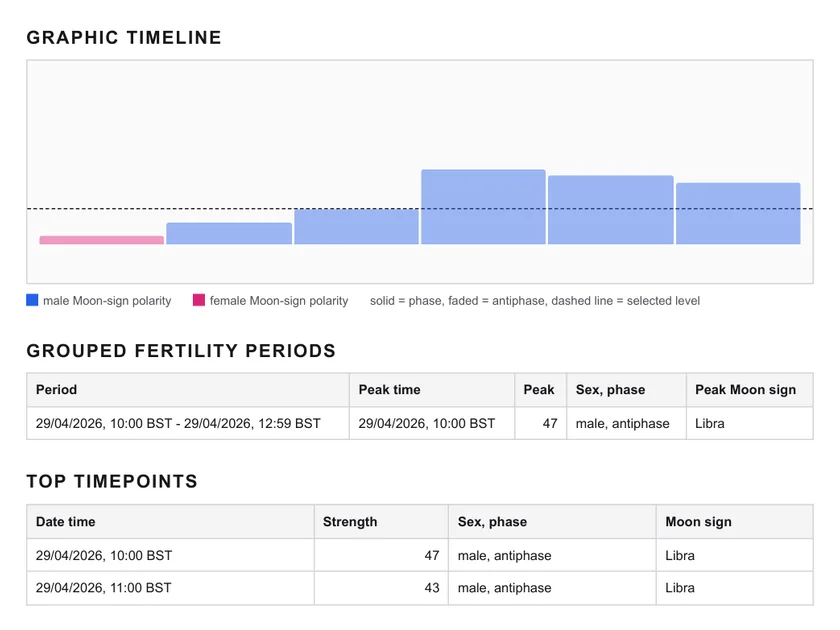
The sample PDF is structured like a fertility calendar with an astrological focus. Start with the strongest windows, then review the peak time, the hourly strength scores, the Moon sign, and the pattern type.
The start and end time show the full period being highlighted. The peak time shows the strongest point inside that window. The strength score shows how favorable each hour is within the symbolic window, with the strongest hours closest to the peak.
The pattern type tells you whether the window belongs to the main lunar phase pattern or the antiphase pattern. The Moon sign gives additional astrological context for reflection, journaling, or planning around emotional tone and personal meaning. The level setting acts as a report threshold: lower levels show more hours, while higher levels keep the focus on stronger windows.
How Fertility Window Astrology Fits Alongside Ovulation Tracking and Fertility Treatment
The Lunar Fertility Windows report is not an ovulation test. It does not detect hormone changes, confirm ovulation, diagnose infertility, or replace medical care. This distinction matters.
Ovulation and fertility awareness tracking are based on biological signs and, in some cases, clinical testing. Fertility treatment may involve physicians, medications, ultrasound monitoring, laboratory procedures, timing protocols, or assisted reproductive technologies. The Lunar Fertility Windows report belongs in a different category: symbolic astrology timing.
That means it can sit beside practical fertility planning support, but it should not be confused with medical guidance. Someone might compare the report with ovulation timing. Another person may use it for journaling or emotional reflection while undergoing fertility treatment. Someone else may simply enjoy seeing how lunar fertility patterns appear across a future calendar.
Used thoughtfully, the report can be a meaningful companion to fertility awareness. Used as a replacement for medical information, it would be outside its purpose.
For readers interested in how Vox Stella is separating symbolic timing from outcome claims, the astrology conception timing study explains the research posture behind collecting real-world conception timing data.
Who This Report May Be Useful For
The report may be useful for people interested in astrology, cycle awareness, and symbolic timing. It may appeal to someone who already tracks ovulation signs and wants to compare those observations with lunar fertility timing.
Because the timing begins with the natal chart, the windows are not generic lunar dates. They are based on the individual's birth Sun-Moon relationship. That makes the report more personal than a general Moon phase calendar.
It may also be useful for astrologers, wellness practitioners, or fertility-focused coaches who want a clear, readable fertility astrology report to discuss with clients. People undergoing fertility treatment may also find it interesting as symbolic support, provided medical instructions always come first.
View the Sample Lunar Fertility Report
The sample PDF shows how Vox Stella presents the Lunar Fertility Windows report: strongest windows, peak times, hourly strength scores, Moon signs, phase or antiphase labels, and symbolic polarity notes. Use it to understand the format before generating or discussing a report.
The sample is especially helpful if you want to see how the report moves from a natal Sun-Moon rhythm to practical timing windows. The preview image above avoids the sample chart header and focuses on the timeline and period tables.
What This Report Is Not
The Lunar Fertility Windows report does not predict pregnancy, determine fertility, confirm ovulation, diagnose infertility, recommend treatment, replace cycle tracking, or replace a doctor. It also does not provide a medical sex-selection method. Traditional Moon-sign polarity should be read symbolically only.
For clinical context, medical fertility guidance defines the biological fertile window around ovulation and recommends professional evaluation when conception is difficult or treatment is involved. Those are medical resources; Vox Stella's report is not.
FAQ
Is the Lunar Fertility Windows report an ovulation test?
No. The report does not detect ovulation or confirm biological fertility. It is an astrology-based timing report that highlights symbolic lunar fertility windows. It may be reviewed alongside ovulation tracking, but it should not replace medical or cycle-based methods.
Can this report help with fertility treatment?
It can be used as a symbolic reflection tool while someone is undergoing fertility treatment, but it is not a treatment plan. Medical instructions from fertility specialists should always come first.
What is a fertility window in this report?
In this report, a fertility window is a period around a symbolic lunar anchor. The anchor is based on a repeating Sun-Moon relationship connected to the natal chart, following the Jonas Method-style lunar phase recurrence process. The strongest hours are closest to the peak time.
What is the difference between phase and antiphase?
Phase means the recurring Sun-Moon relationship is on the same branch as the natal pattern. Antiphase means the same elongation appears on the opposite waxing or waning branch. It does not mean the Moon is simply 180 degrees away.
Is this the Jonas Method?
It implements the core Jonas Method-style lunar phase recurrence process: natal Sun-Moon relationship, future recurrence windows, and Moon-sign polarity labels. Vox Stella presents it as symbolic fertility timing, not as a validated medical method.
Can Vox Stella calculate Jonas Method dates?
Vox Stella can calculate symbolic Jonas Method-style lunar fertility windows from a saved natal chart and selected date range. It should be read as an astrology timing report, not as a medical fertility calculator.
Should I use the mother's chart or the father's chart?
Use the mother's chart, meaning the natal chart of the woman or person whose fertility window is being examined. The father's chart does not generate the Jonas Method-style lunar fertility windows in this report.
If sperm determines chromosomal sex, why does the report use the mother's chart?
Because the mother's chart generates the Jonas-style lunar timing window. The boy/girl label is then read from the Moon-sign polarity around that window. It is a traditional astrology marker, not a biological mechanism or guarantee.
What birth data is needed for lunar fertility timing?
The scan works best from a complete natal chart, which means birth date, accurate birth time, and birth place. The birth time matters because the report is based on the natal Sun-Moon relationship rather than a generic Moon calendar.
Should lunar fertility timing be used for contraception?
No. This report should not be used as contraception or as a substitute for medical family-planning advice. It is a symbolic astrology timing tool only.
Does the report predict pregnancy?
No. The Lunar Fertility Windows report does not predict or guarantee pregnancy. It identifies symbolic timing patterns based on astrology. Pregnancy depends on many biological, medical, and personal factors.
What does the Moon sign mean in the report?
The Moon sign gives astrological context for each window. In the boy/girl context, some traditions associate Moon signs with symbolic male or female polarity, but this should not be read as a prediction, guarantee, or sex-selection method.
Is this report only for people trying to conceive naturally?
No. It may be used by anyone interested in lunar fertility timing, including people tracking cycles, exploring fertility astrology, or navigating fertility treatment. Its role remains symbolic and reflective in every case.
Sources and Useful Reading
- Lunarium: Lunar Conception and the Jonas Method
- Astrodienst Astrowiki: Eugen Jonas
- The Skeptic's Dictionary: Dr. Eugen Jonas
- Conception Election Highlights in Vox Stella
- Call for Couples: Astrology Conception Timing Study
- Vox Stella Windows product page
- Johns Hopkins Medicine: Calculating Your Monthly Fertility Window
- ACOG: Evaluating Infertility