 Vox Stella
If you are asking "Will my dog come home?", a good lost dog horary example should show more than theory. It should show a real chart, a clear judgment, and a practical way to read the search clues without overclaiming.
That is what this post does.
It uses a replay of a documented missing-dog case and shows how Astro Clock handled it. The documented real-world outcome was simple and important: the dog was later recovered. In the replay, we used the prompt "Will my dog come home?" with the chart inputs listed below. Astro Clock returned Judgment: YES with 84% confidence, classified the chart as a missing-pet question, and produced ranked horary location clues.
That alignment on recovery is the headline. The location output matters too, but it should be read correctly. These clues are search hints, not proof of an exact place. That distinction matters in any serious lost pet horary workflow.
How we replayed the case in Astro Clock
This was a replay of a documented case, not a live consultation. Keeping those layers separate is the honest way to present it.
- Documented real-world outcome: the dog was later recovered.
- Replay prompt used in the app: "Will my dog come home?"
- Software return: structured judgment, confidence, classification, and ranked location clues.
That replay prompt matched the scenario, but it is not being presented as the exact sentence used in the original case.
Exact app inputs
- Date: 2025-01-06
- Time: 23:19
- Location: Naples, New York
- Timezone: America/New_York
- House system code: R
Inside the app, the workflow was straightforward. We cast the chart, reviewed the Judgment panel first, then checked the Moon Story and Considerations, and finally opened Location Clues to see the ranked search guidance.
What the software returned
The top-line result came back as:
- Judgment: YES
- Confidence: 84%
- Question type: pet
- Pet family: missing
- Perfection type: pet_missing_balance
In plain language, the app recognized this as a missing pet horary question and judged it through a dedicated pet-recovery framework rather than treating it as a generic event chart.
The key reasoning themes returned by the app were also specific:
- Missing-pet questions are judged through the 6th-house pet significator
- Moon testimony added supportive movement toward recovery
- The pet significator was retrograde, favoring return or retracing
- The chart judged recovery and location rather than treating the question as a generic event question
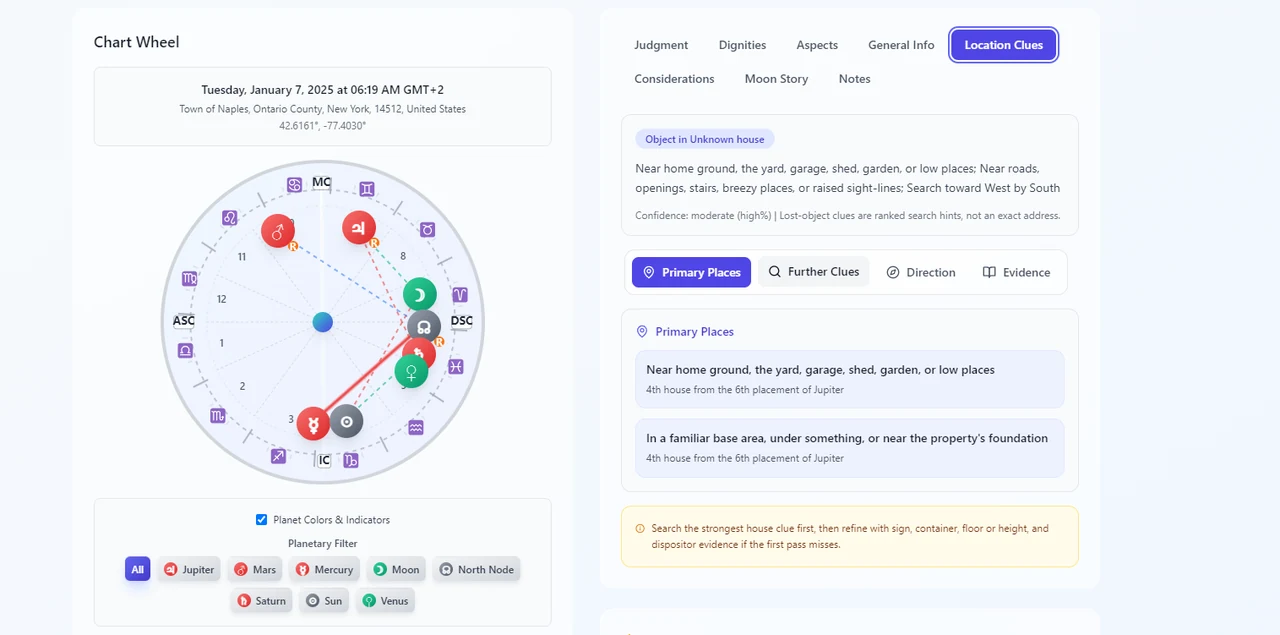
The app also returned the following location clues.
Summary
Near home ground, the yard, garage, shed, garden, or low places; Near roads, openings, stairs, breezy places, or raised sight-lines; Search toward West by South
Primary Places
- Near home ground, the yard, garage, shed, garden, or low places
- In a familiar base area, under something, or near the property's foundation
Further Clues
- At a public, professional, or visible place where people would notice the pet
- Near roads, openings, stairs, breezy places, or raised sight-lines
- Between places, on the move, along a route, or near bags, containers, or openings
Direction
- West by South
Confidence note: Missing-pet location clues are ranked search hints, not an exact address.
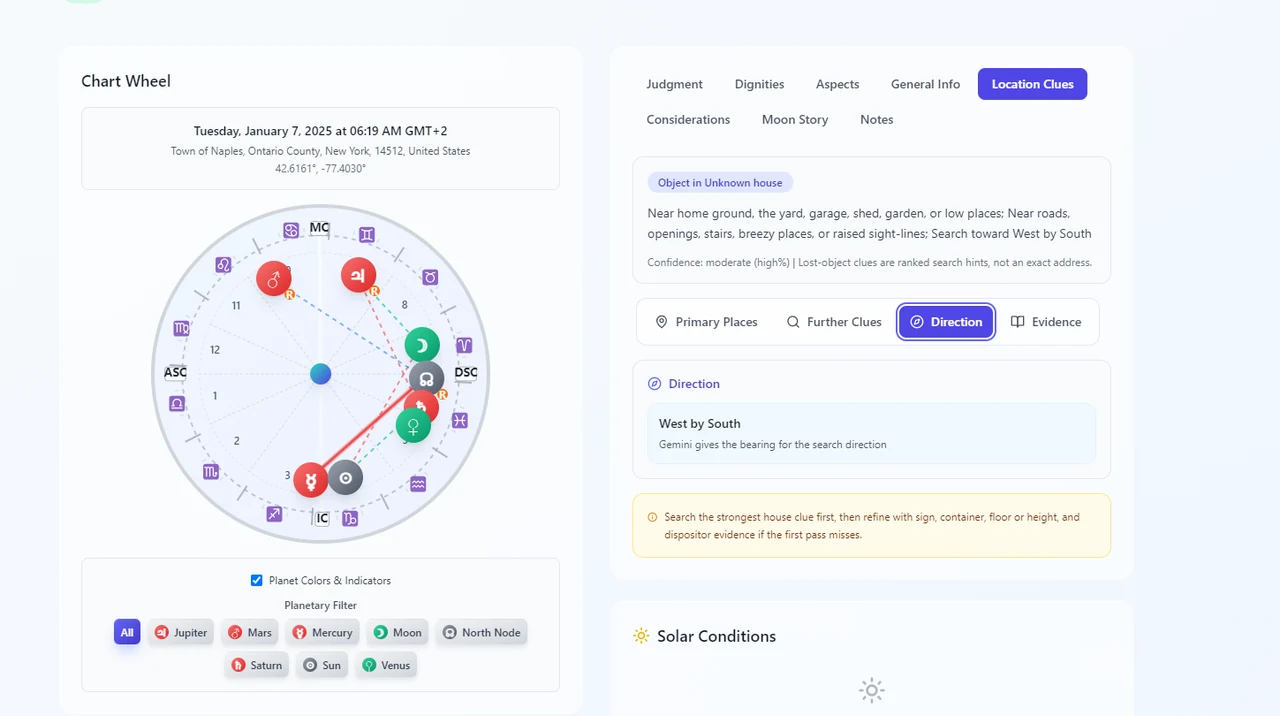
That last line is one of the strongest parts of the feature. A good lost dog astrology chart should help structure a search, not pretend it has replaced real-world evidence.
How to read a lost dog horary chart
A lot of confusion around lost pet astrology comes from reading everything at once. A better approach is to move in order.
Start with the pet significator
In this workflow, lost-pet questions are judged through the 6th-house pet significator. That is the first anchor. Before you start chasing scenery or directions, you need to know which part of the chart is carrying the pet question.
Judge recovery before chasing location
The first question in a lost dog horary question is not "Where exactly is the dog?" It is "Does the chart support recovery?"
In this replay, Astro Clock judged YES. That aligns with the documented real-world outcome: the dog was later recovered.
That order matters. Once the recovery judgment is clear, the location clues become more practical. They stop being random details and start becoming search priorities.
Use the Moon story to understand movement
The app noted that Moon testimony added supportive movement toward recovery. In horary astrology pet recovery work, that kind of testimony helps describe whether the story is moving toward reunion, delay, or drift.
In this case, the Moon helped strengthen the recovery side of the chart rather than leaving the question flat or stalled.
Take retrograde seriously in missing-pet charts
The app also flagged that the pet significator was retrograde, favoring return or retracing. In a horary lost dog example, that is a meaningful theme. Retrograde symbolism does not prove what a dog will do, but it can support the idea of circling back, retracing a route, or returning to a familiar area.
That is especially useful in field searches, because it suggests checking not just outward paths but also return paths, familiar edges, and places the pet already knows.
Read location clues as ranked search passes
This is where many readers overreach. The app did not return a street address. It returned ranked search clues.
In this replay, the strongest pass began near home ground: the yard, garage, shed, garden, low places, and familiar base areas. The next pass broadened into routes and exposure: roads, openings, stairs, breezy places, raised sight-lines, visible places, and in-between spaces where the pet could be moving along a path.
The directional bias was West by South.
Used well, that becomes a practical search order:
- Start with the property and near-home zones
- Check low, covered, or tucked-away spaces first
- Expand toward routes, openings, and visible edges
- Use West by South as a directional bias in the next search pass
Keep the reading tied to evidence
A missing-pet horary reading should sit beside real action: calling shelters and vets, checking cameras, notifying neighbors, updating microchip records, and searching on foot.
Horary can help organize attention. It should not replace posters, calls, maps, or eyewitness reports.
What this case confirms
The strongest confirmation in this case is simple: the real-world outcome was recovery, and the software also judged YES.
That is the main alignment, and it is the only claim worth making strongly.
This replay also shows why workflow matters. In a stressful will my dog come home horary situation, raw symbolism is not enough. Users need a structured path: identify the question correctly, judge recovery first, review the Moon story, note return symbolism like retrograde motion, and then convert location language into ranked search passes.
Limits of the reading
There are real limits here, and they should be stated plainly.
- This was a replay of a documented case, which is useful for study because the outcome is known.
- The sentence "Will my dog come home?" was the replay prompt used in the software. It matches the situation, but it is not being presented as the exact original wording from the documented case.
- The location clues are ranked hints, not proof of an exact spot.
- 84% confidence is a software output, not certainty.
Ethics note: astrology does not replace evidence, emergency action, or practical search work. In any lost-pet situation, use horary as one layer of structured inquiry alongside real-world recovery steps.
Why this workflow matters
The best lost pet horary tools do not flatten astrology into a gimmick. They make traditional rules easier to apply consistently.
That is what Astro Clock is built to do. You can cast the chart, review structured judgment, trace the Moon story, read considerations, and work through location clues inside a readable interface. For beginners, that lowers the barrier to learning. For experienced users, it makes the logic easier to audit, explain, and share.
In other words, the software does not replace judgment. It helps you use judgment better.
Try the lost-dog horary workflow
Cast a lost dog horary chart in Astro Clock and review the judgment, Moon story, considerations, and ranked location clues in one place. It is a practical way to study lost pet horary without turning a stressful question into guesswork.
FAQ
What is a lost dog horary question?
A lost dog horary question is a horary question asked about a missing dog, usually focused on recovery, return, or search guidance. In this workflow, the question is treated as a dedicated pet question rather than a generic event question.
How do you judge a lost pet horary question?
Start by identifying the pet significator, then judge recovery before location. After that, review the Moon story, note return themes such as retrograde motion, and only then move into ranked location clues.
Can horary astrology tell me exactly where my missing pet is?
No responsible reader should claim that. Horary can return location clues and directional hints, but those should be treated as exploratory search guidance rather than a literal address.
What does retrograde mean in a horary astrology lost dog chart?
In a missing-pet context, retrograde can support themes of return, retracing, or moving back toward familiar ground. It is not a guarantee, but it can strengthen a recovery reading and help shape the search strategy.
Why use horary software for lost pet questions?
A good lost-pet horary workflow makes the chart easier to read under pressure. Instead of piecing everything together manually, you can review structured judgment, testimonies, Moon story, considerations, and location clues in one interface.