 Vox Stella
Getting married comes with a thousand moving parts - venues, family schedules, budgets - and for many couples, one deceptively simple question stalls everything: "What's a good day to get married... astrologically?" You've probably seen conflicting tips online: "don't marry in Mercury retrograde," "check Venus," "ask a priest for a muhurat," or "just pick a date already." This practical guide cuts through the noise with a clear process you can use today - grounded in traditional electional astrology and made easier with software. If you want to skip ahead and try it, jump to How to Use the Election Scanner or explore related tools like Transits, Trait Profile, and Forensic timing.
Need a ceremony-first overview? Read How to Choose a Wedding Date for Morin-style rules, Moon/Venus checklists, and tips for weaving the Vox Stella election scanner into your planning binder.
Meta: wedding muhurat, vivah muhurat, auspicious wedding dates, electional astrology for marriage, wedding election chart, 7th house election, Venus retrograde wedding, Mars retrograde wedding, Mercury retrograde wedding, void-of-course Moon wedding, benefic aspects, essential dignity, wedding date astrology by city.
What "electional" means (in plain English)
Electional astrology picks a start time that supports the purpose of an event - in this case, marriage. In traditional Western practice, astrologers favor strong Venus/Jupiter/Moon placements and minimize harsh conditions affecting the Ascendant and the 7th house (marriage). Should you only check transits? Avoid retrogrades? Blend both partners' charts? The pragmatic answer most couples land on: use both the sky and your constraints, then layer your personal charts if available. In South Asian traditions, couples often look for a Vivah Muhurat - an auspicious window computed from almanacs and/or the couple's birth details. Apparent conflicts across websites usually come down to generic lists vs. city-specific or personalized calculations - and the ceremony's exact hour matters.
Why wedding-date research online feels confusing
- Conflicting sources. One site's "good" day is another's "avoid." That's common when generic lists ignore your city and ceremony hour.
- Retrograde panic. Threads debate whether Mercury (or Venus/Mars) retrograde "ruins" weddings. The nuance: retrogrades highlight logistics and communications; they don't doom love.
- Cultural layers. A priest or astro-consultant may choose narrow windows - sometimes at awkward hours - while your venue requires a weekend afternoon.
Software can simplify this: apply time-tested checks, respect your practical limits, and show why a time is good in plain language.
Meet the Electional Marriage Scanner
- Auspicious Marriage Timing. Finds favorable windows for weddings, blending classical signals with modern usability.
- Tradition Meets Practicality. Translates rules into everyday language - no jargon maze - so you can share with partners and family.
- Custom Boundaries. Set date range, city/zone, allowed weekdays, and ceremony hours; only get results that fit your life.
How to use the Election Scanner (step-by-step)
1) Define your scope
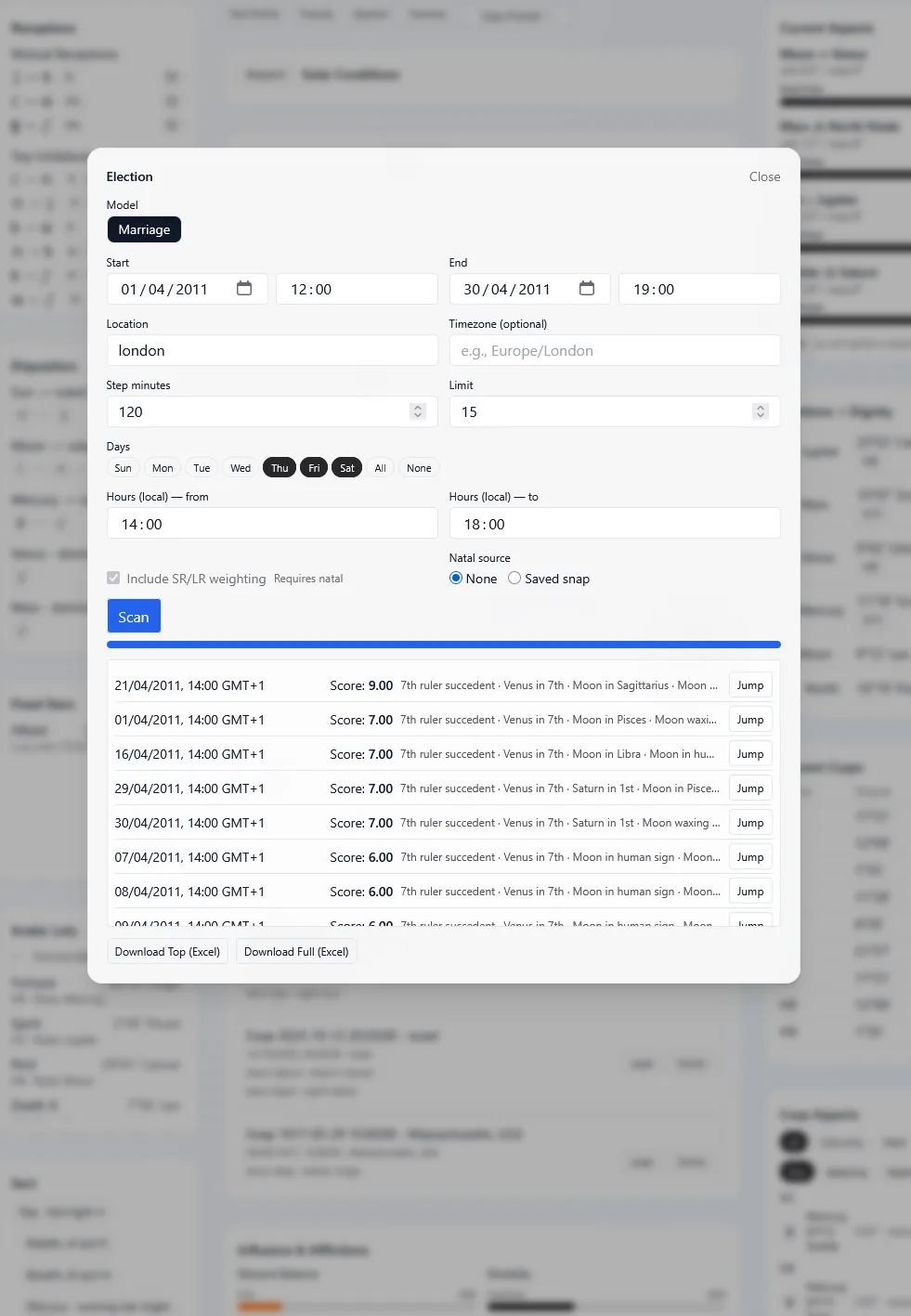
Pick a date window (e.g., May - July), enter your location, choose allowed weekdays (Sat/Sun only?), and set time bands (say 14:00 - 18:00 local). The app respects your schedule out of the box. You'll avoid generic 3 a.m. "best times" that ignore real life.
2) Personalize with natal data (optional)
Add saved birth charts for one or both partners to tailor the scoring (e.g., the Moon trining your natal Venus gives a boost). If you don't add charts, transit-based picks still work great. For added context around the season you're considering, skim Transits to see which themes are active near your target dates.
3) Scan and explore
Tap Scan to run a fast pass. You'll see each candidate time with a score and a one-line "why it's auspicious." Click Jump to open the chart view, or Export to Excel to share with your planner, priest, or family. Want a deeper picture of your relationship's strengths? Try a Trait Profile to balance practical timing with personal dynamics.
Why this is different (and helpful)
- Clear & Traditional. Classical signals (Venus/Jupiter/Moon, angles, malefic pressure) are translated into plain English.
- Life-Aligned Results. Your weekday/hour filters ensure suggestions fit your calendar.
- Adaptable Depth. With natal charts added, it gets personal; without them, it remains robust on transits alone.
- Defensible Timing. Each pick shows its short reasoning trail - handy when relatives, vendors, or a Reddit thread second-guess your date.
Practical do's & don'ts from real questions
- Do use a city-specific scan and realistic ceremony hours. Generic lists often ignore your time zone or suggest impossible times.
- Don't assume you must cancel because of Mercury retrograde. If a retrograde window is unavoidable, pick a chart that strengthens the Ascendant/7th, Moon, and Venus - then double-check contracts, travel, and communications. A quick pass in Transits clarifies the logistics picture.
- Do reconcile family traditions with planning constraints. If you need a weekend muhurat in Seattle next spring, use the scanner to surface weekend-friendly windows and bring that shortlist to your priest for refinement.
- Don't rely on a single website's "good/avoid" tag without context. Different methods produce different answers; use a tool that shows its work.
Example: a real-life workflow
- You're targeting late May - June in London, Saturdays between 14:00 - 18:00.
- Run the Marriage model with a 120-minute step and a limit of 15 results.
- Review the shortlist: perhaps May 29, 14:00 scores 9.0 (Venus dignified; Moon applying to a benefic; 7th ruler succedent).
- Click Jump to inspect the chart; export the top five to send your planner - and your in-laws.
This "show your work" approach reduces second-guessing ("why this day?") and avoids the classic "someone says our date is unlucky - now what?" dilemma. If you're reviewing past milestones - engagement, move-in, or even first date - the Forensic view helps you study timing patterns with an auditable trail.
What makes a strong Western wedding election?
There's no one recipe, but many astrologers prioritize:
- Dignified Venus and Jupiter. Essential dignity, sign/house fit, and helpful aspects set a supportive tone for love and stability.
- Protected angles. Fortify the Ascendant/Descendant axis; avoid severe afflictions to the 1st/7th rulers.
- Cooperative Moon. Productive sign/phase, helpful applying aspects, avoid extended void-of-course periods.
- Clean chart tone. Balance malefic pressure; keep key significators out of debilitating conditions (over-combustion, harsh squares without mitigation, etc.).
The scanner translates these principles into a composite score and a one-line explanation you can explain to anyone.
FAQ: real questions, clear answers
Q1: How do I find the best day to get married - do I check our horoscopes or just avoid retrogrades?
A: Do both. Scan a date range for strong charts within your availability and - if you have birth data - weight the results with both natal charts. That's the fastest, most practical path.
Q2: Is a Mercury retrograde wedding "bad"? Should we move the date?
A: Not inherently. Retrogrades emphasize logistics and communications. Choose a chart that strengthens the Ascendant/7th, Moon, and Venus, and plan for contracts, travel, and coordination. When in doubt, check the Transits panel for a quick sanity check.
Q3: Our families want a muhurat, but weekend dates are limited. What now?
A: Use the scanner to find weekend-friendly windows in your city. Bring that shortlist to your priest/consultant for cultural refinement. Couples report this blend works well.
Q4: Why do different websites list different "good days"?
A: Methods vary - generic calendars vs. personalized flows - and time zones shift windows. A location-aware tool with transparent rules avoids mixed messages.
Q5: What should I prioritize in a Western election?
A: Favor dignified Venus/Jupiter/Moon, protect the Ascendant & 7th, avoid brutal malefic hits, and add natal overlays for nuance.
Q6: We already booked a date and someone said it's unlucky. Are we doomed?
A: No. You can still optimize the time within that day and handle logistics carefully. Many couples report happy outcomes regardless.
Q7: Is the tool inclusive for queer couples and mixed traditions?
A: Yes. Electional logic is about charts and timing, not gender. If you follow Vedic guidelines, you can still filter for practical windows and share them for a personalized Vivah Muhurat.
What is the best day to get married by astrology?
The best date balances strong Venus/Jupiter/Moon placements and a protected Ascendant/7th house, while fitting your city, weekday, and ceremony hour. Use an electional tool to scan a date range, weight with your birth charts if available, and shortlist times with clear reasons.
Try it now
Plan with clarity - scan your dates in minutes and pick a chart you can explain to anyone.